

Augustus
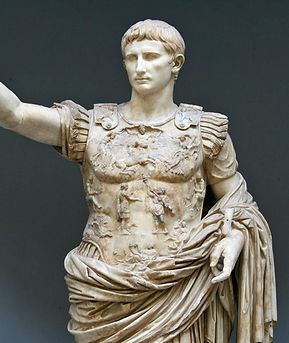
(63 BC-14 AD)
BIRTH
63 BC
PLACE
Rome, Italy
NAME
Gaius Octavius
DEATH
14 AD
PLACE
Nola, Italy
FAMILY

FATHER
Gaius Octavius
(d. 58 BCE)

MOTHER
Atia
(c. 85 BCE–43 BCE)

SISTER
Octavia the Younger
(69 BC-11 BC)

WIFE
Clodia Pulchra
(c. 60–41 BCE or later)

WIFE
Scribonia
(c. 70 BC-after 16 AD)

WIFE
Livia Drusilla
(58 BC-29 AD)

CHILDREN
Drusus the Elder
(38 BC-9 BC)

CHILDREN
Tiberius
(42 BC-37 AD)
HOMES

Palazzo a Mare (Roman Villa), Capri
Capri, Italy

House of Augustus, Palatine Hill
Rome, Italy
NICKNAMES
Divi filius
RELIGIOUS VIEWS
ROMAN POLYTHEIST
MEMBERSHIPS
ARVAL BRETHREN MEMBER, FETIAL COLLEGE MEMBER, QUINDECIMVIRI SACRIS FACIUNDIS MEMBER, ROMAN COLLEGE OF AUGURS MEMBER, ROMAN COLLEGE OF PONTIFFS MEMBER, SEPTEMVIRI EPULONUM MEMBER, SODALES TITII MEMBER
AWARDS
CIVIC CROWN RECIPIENT, DEIFIED, GOLDEN SHIELD OF VIRTUE RECIPIENT, OVATION RECIPIENT, ROMAN TRIUMPH
Augustus was the first Roman emperor, who rose to power as the adopted heir of Julius Caesar and ruled from 27 BC to AD 14, establishing the Roman Principate and a long era of peace. The triumvirs defeated Caesar's assassins at Philippi in 42 BC. In 27 BC the Senate gave him the name Augustus. His reign began the Pax Romana. Augustus outlived several chosen heirs and finally adopted his stepson Tiberius. The month of August is named for him.
EARLY LIFE
Gaius Octavius was born on September 23, 63 BC, in Rome, the son of Gaius Octavius, a senator from a wealthy family of Velitrae, and Atia, a niece of Julius Caesar. His father died when he was four, and he was raised partly by his grandmother Julia, Caesar's sister. As a teenager he attracted the attention of his great-uncle, who took an interest in his career and brought him into public life. In 44 BC, when he was eighteen and studying in Illyricum, news came that Caesar had been assassinated and had adopted him as his son and heir in his will.
Augustus began his rise as Octavian, the adopted heir of Julius Caesar, after Caesar's assassination in 44 BCE. He raised troops and maneuvered among rival factions before joining Mark Antony and Lepidus in the legally established Second Triumvirate. Their proscriptions involved confiscations and killings, including Cicero's death. Defeating Caesar's assassins at Philippi in 42 BCE did not restore republican peace; the triumvirs competed over territory, armies, and political authority.
Octavian secured Italy and the western provinces while Antony's power centered on the east. War against Sextus Pompey and the displacement of Lepidus strengthened Octavian's position. Propaganda against Antony and Cleopatra framed their rivalry as a defense of Roman interests. Victory at Actium in 31 BCE, followed by the conquest of Egypt and their deaths, left him without a comparable rival. His success depended heavily on commanders including Marcus Agrippa and on the resources mobilized through years of civil conflict.
In 27 BCE the Senate awarded the name Augustus as he presented a settlement claiming to restore traditional government. Republican offices and the Senate continued, but his control of key armies, provinces, and exceptional powers established a monarchy in practice. He reorganized military service, provincial administration, taxation, and public works. Building programs and literary patronage promoted an image of renewal, while moral legislation sought to regulate elite marriage and conduct. The peace associated with his reign followed civil-war victory but did not eliminate warfare on the empire's frontiers.
Expansion and campaigns strengthened Roman control in some regions, while disaster in Germany in 9 CE exposed its limits. Augustus confronted repeated difficulties in arranging succession as intended heirs died. Family politics also involved the exile of his daughter Julia and restrictions that reveal the coercive side of his moral program. He ultimately adopted Tiberius, who succeeded after Augustus died in 14 CE. His own account, the Res Gestae, presents achievements selectively and must be compared with other evidence. His career created a durable framework for imperial rule by combining military dominance, negotiated elite cooperation, and public representation of continuity. Its institutions brought stability after prolonged conflict while concentrating authority and narrowing the possibilities of independent republican politics.
CAREER
DEATH
Augustus's illness in 23 BC accentuated the problem of succession. To ensure stability, he needed to designate an heir. This needed to be done subtly so that it did not trigger fears of monarchy. If someone was to succeed to Augustus's position of power, he would first have to be recognized as meritful. Some historians argue that Augustus favored his nephew Marcellus, who had married Augustus's daughter Julia, while others argue that he preferred Marcus Agrippa, who was Augustus's second in charge and a respected military commander. After Marcellus died in 23 BC, Augustus remarried his daughter Julia to Agrippa in 21 BC. This union produced five children, three sons and two daughters. In 18 BC, Agrippa was granted a five-year appointment to the eastern provinces with proconsular imperium and also the tribunicia potestas that Augustus possessed. This grant showed Augustus's favor but upset some conservative senators. Augustus adopted his grandsons Gaius and Lucius, illuminating his intent to make them his heirs. He served as consul in 5 and 2 BC so that he could personally usher them into their political careers. Gaius was consul for AD 1, with Augustus having him wait until he turned 21, while Lucius died before his designated consulship. Augustus also showed favor to his stepsons Tiberius and Drusus, granting them public offices while seeming to favor Drusus. Tiberius married Agrippa's eldest daughter, Vipsania Agrippina, while Drusus married Augustus's niece Antonia.
Mausoleum of Augustus, Rome
Piazza Augusto Imperatore, Rome, RM, Lazio, Italy

GRAVE


PARK
Colosseum, Roman Forum & Palatine Hill
Piazza del Colosseo, 1, Rome, Lazio 00184, Italy


PARK
Philippi Archaeological Site
near Kavala, Greece


PARK
Baths of Agrippa, Rome

PARK
Domus Transitoria, Palatine Hill
Via di San Gregorio 30 (Palatine Hill entrance), Rome, Lazio, Italy


MONUMENT
Trophy of Augustus, La Turbie
Avenue Albert 1er, 06320 La Turbie, France

MONUMENT
Aqua Virgo Aqueduct, Rome
Via del Nazareno 9/a, Rome, Lazio, Italy

PARK
Forum of Augustus, Rome
Piazza del Grillo 1, Rome, Lazio, Italy


PARK
Temple of Divus Julius (Temple of Caesar)
Rome, RM, Lazio, Italy

PARK
Villa of Livia, Prima Porta
Via della Villa di Livia 187, Rome, Lazio, Italy


PARK
House of Livia, Palatine Hill
Via di San Gregorio 30 (Palatine Hill entrance), Rome, Lazio, Italy

PARK
House of Augustus, Palatine Hill
Via di San Gregorio 30 (Palatine Hill entrance), Rome, Lazio, Italy


MARKER
Actium Battlefield Site, near Preveza
Actium, Preveza, Epirus, Greece

PARK
Apollonia, Albania
Apollonia, Fier County, Albania

MARKER
Caesareum of Alexandria
Alexandria, Alexandria Governorate, Egypt
POPULAR BIOGRAPHIES
1. Augustus: First Emperor of Rome — Adrian Goldsworthy. Find on Amazon
2. Augustus: The Life of Rome's First Emperor — Anthony Everitt. Find on Amazon
3. Augustus: The Biography — Jochen Bleicken. Find on Amazon
4. The Age of Augustus — Werner Eck. [Life and reign] Find on Amazon
5. Augustus — Pat Southern. Find on Amazon
103592