

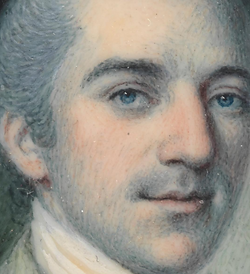
John Laurens
BIRTH
Oct 28, 1754
Charleston, South Carolina
DEATH
August 27, 1782
Beaufort County, South Carolina
FAMILY
FATHER:

Henry Laurens
(1724-1792)
MOTHER:

Eleanor Ball Laurens
(1731-1770)
##
Laurens, John
(1754-1782)
John Laurens was an American soldier and statesman from South Carolina during the American Revolutionary War, best known for his criticism of slavery and his efforts to help recruit slaves to fight for their freedom as U.S. soldiers.
GRAVE:
GRAVE
Laurens Family Cemetery
Mepkin Abbey Rd, Moncks Corner, SC 29461

10
BROTHER

Henry Laurens
(1724-1792)
SISTER
Martha Laurens Ramsay
(1759-1811)
WIFE
Martha Manning Laurens
(1757-1781)
Henry Laurens
(1724-1792)
Places | Image | Address | GPS | Site |
|---|---|---|---|---|
Colonial Williamsburg | 101 Visitor Center Dr, Williamsburg, VA 23185 | MUSEUM | ||
DeWint House | 20 Livingston St, Tappan, NY 10983 | MUSEUM | ||
Monmouth Battlefield State Park | 20 NJ-33 Business, Manalapan Township, NJ 07726 | MUSEUM | ||
Yorktown - Surrender Field | Historical Tour Road, Yorktown, Virginia, 23690, USA | MUSEUM | ||
Van Wyck Homestead Museum | 504 US-9, Fishkill, NY 12524 | MUSEUM | ||
Yorktown - Redoubt 10 | Historical Tour Road, Yorktown, Virginia, 23690, USA | MUSEUM | ||
Moore House | 228 Nelson Rd, Yorktown, VA 23690 | MUSEUM | ||
Battle of Tar Bluff Location | Fields Point Lane, Wiggins, South Carolina, USA | MARKER | ||
76 House - Andre's Jail | 110 Main St, Tappan, NY 10983 | MARKER | ||
Major John Andre Hanging Site Marker | 161 Old Tappan Rd, Tappan, NY 10983 | MARKER |
DIED:
Beaufort County, South Carolina
Aug 27, 1782


John Laurens was born in Charleston, South Carolina, on October 28, 1754, to Henry Laurens and Eleanor Ball Laurens, both of whose families were prosperous as planters cultivating rice. In October 1771, Laurens's father moved with his sons to London, and Laurens was educated in Europe from the ages of 16 to 22. For two years beginning in June 1772, he and one brother attended school in Geneva, Switzerland, where they lived with a family friend. Upon returning to London in August 1774, he yielded to his father's wish that he study law. In November 1774, Laurens began his legal studies at the Middle Temple. Laurens's father returned to Charleston, leaving Laurens as guardian to his brothers, both enrolled in British schools.
Laurens arrived at Charleston in April 1777. That summer he accompanied his father from Charleston to Philadelphia, where his father was to serve in the Continental Congress. Henry Laurens, finding himself unable to prevent his son from joining the Continental Army, used his influence to obtain a position of honor for his 23-year-old son. General George Washington invited Laurens to join his staff in early August, as a volunteer aide-de-camp.
Laurens became close friends with two of his fellow aides-de-camp, Alexander Hamilton and the Marquis de Lafayette. He quickly became known for his reckless courage upon first seeing combat on September 11, 1777, at the Battle of Brandywine during the Philadelphia campaign. After spending the remainder of the winter of 1777–1778 encamped at Valley Forge, Laurens marched to New Jersey with the rest of the Continental Army at the end of June 1778, to face the British at the Battle of Monmouth.[6] Near the start of battle, Laurens had his horse shot out from under him while he did reconnaissance for Baron von Steuben.
On December 23, 1778, Laurens engaged in a duel with General Charles Lee just outside Philadelphia, after Laurens took offense to Lee's slander of Washington's character. Lee was wounded in the side by Laurens's first shot and the affair was ended by the men's seconds, Alexander Hamilton and Evan Edwards, before Laurens or Lee could fire a second shot. Laurens was taken prisoner by the British in May 1780, after the fall of Charleston. As a prisoner of war, he was shipped to Philadelphia, where he was paroled with the condition that he would not leave Pennsylvania. In March 1781, Laurens and Thomas Paine arrived in France to assist Benjamin Franklin, who had been serving as the American minister in Paris since 1777. Together, they met with King Louis XVI, among others. Laurens gained French assurances that French ships would support American operations that year; the promised naval support was later to prove invaluable at the Siege of Yorktown.