

Richard Nixon
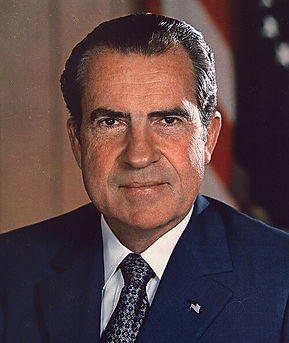
(1913-1994)
BIRTH
January 9, 1913
PLACE
Yorba Linda, California, USA
NAME
Richard Milhous Nixon
DEATH
April 22, 1994
PLACE
New York, New York, USA
FAMILY

FATHER
Francis A. Nixon
(1878–1956)
MOTHER
Hannah Milhous Nixon
(1885–1967)
WIFE
Pat Nixon
(1912-1993)
HOMES
NICKNAMES
Tricky Dick
POLITICAL VIEWS
DETENTE ADVOCATE, UNITED STATES–CHINA RELATIONS NORMALIZATION ADVOCATE
REPUBLICAN
RELIGIOUS VIEWS
CHRISTIAN
QUAKER
MEMBERSHIPS
ORTHOGONIAN SOCIETY CO-FOUNDER, ORTHOGONIAN SOCIETY FOUNDING PRESIDENT, WHITTIER COLLEGE TRUSTEE
AWARDS
California lawyer, congressman, and Eisenhower's vice president, Nixon was elected the 37th U.S. president in 1968, opened relations with China, and resigned on August 9, 1974, over the Watergate scandal. He practiced law in Whittier and in 1940 married Thelma "Pat" Ryan, a teacher. Nixon served in the U.S. Navy in the South Pacific during World War II, then won a California seat in the U.S. House in 1946. He died in New York City on April 22, 1994.
EARLY LIFE
Richard Milhous Nixon was born on January 9, 1913, in Yorba Linda, California, the second of five sons of Frank Nixon, a streetcar motorman turned grocer, and Hannah Milhous Nixon, a Quaker. In 1922 the family moved to Whittier, where they ran a grocery store and gas station. Two of his brothers, Harold and Arthur, died young. Nixon graduated from Whittier College in 1934 and attended Duke University School of Law on a scholarship, graduating in 1937 near the top of his class. He practiced law in Whittier and in 1940 married Thelma "Pat" Ryan, a teacher.
Richard Nixon began his national political career after wartime naval service, winning election to the House of Representatives from California in 1946. The Alger Hiss investigation established his reputation as an aggressive anticommunist. Elected senator in 1950, he became Dwight Eisenhower's running mate in 1952. As vice president from 1953 to 1961 he travelled extensively, represented the administration abroad and increased the office's visibility. He lost the 1960 presidential and 1962 California gubernatorial elections.
Nixon returned to electoral politics and won the presidency in 1968, promising order at home and an end to the Vietnam War. His administration pursued Vietnamization, reducing American ground forces while expanding bombing and operations into Cambodia. The widening conflict intensified opposition and caused extensive suffering. The Paris agreement of 1973 preceded the withdrawal of remaining American combat troops but did not secure a lasting peace in Vietnam. Nixon's 1972 visit to China opened a major diplomatic channel, while agreements with the Soviet Union advanced détente and nuclear arms limitation. These initiatives reflected a pragmatic pursuit of power relationships across ideological divisions.
Domestic measures included creation of the Environmental Protection Agency, wage and price controls and the ending of dollar convertibility into gold. His administration oversaw substantial school desegregation while cultivating a political strategy that appealed to voters resistant to rapid social change. Conflicts over executive authority, surveillance and the treatment of opponents accompanied these achievements. Nixon won a landslide reelection in 1972, but the break-in at Democratic headquarters in the Watergate complex and the subsequent cover-up increasingly dominated his second term.
Investigations uncovered abuses by campaign and administration personnel, and White House tapes supplied evidence. Nixon dismissed special prosecutor Archibald Cox during the Saturday Night Massacre in 1973. After the Supreme Court ordered release of subpoenaed recordings, evidence of his participation in obstructing the investigation destroyed remaining congressional support. Facing impeachment, he resigned effective 9 August 1974, the only American president to do so. Gerald Ford later pardoned him. Nixon spent subsequent years writing and commenting on foreign affairs. His diplomacy remains inseparable from the abuses that ended his presidency.
CAREER
DEATH
Nixon suffered a severe stroke on April 18, 1994, while preparing to eat dinner in his home at Park Ridge, New Jersey. A blood clot resulting from the atrial fibrillation he had suffered for many years had formed in his upper heart, broken off, and traveled to his brain. He was taken to NewYork-Presbyterian Hospital in Manhattan, initially alert but unable to speak or to move his right arm or leg. Damage to the brain caused swelling (cerebral edema) and Nixon slipped into a deep coma. He died at 9:08 p.m. on April 22, 1994, with his daughters at his bedside. He was 81 years old. Nixon's funeral took place on April 27, 1994, in Yorba Linda, California. Eulogists at the Nixon Library ceremony included President Bill Clinton, former secretary of state Henry Kissinger, Senate Minority Leader Bob Dole, California governor Pete Wilson, and the Reverend Billy Graham. Also in attendance were former presidents Ford, Carter, Reagan, George H. W. Bush, and their wives. Richard Nixon was buried beside his wife Pat on the grounds of the Nixon Library. In keeping with his wishes, his funeral was not a full state funeral, though his body did lie in repose in the Nixon Library lobby from April 26 to the morning of the funeral service. Mourners waited in line for up to eight hours in chilly, wet weather to pay their respects. At its peak, the line to pass by Nixon's casket was three miles long with an estimated 42,000 people waiting.
Richard Nixon Presidential Library and Museum grounds
18001 Yorba Linda Boulevard, Yorba Linda, CA 92886, USA

GRAVE
POPULAR BIOGRAPHIES
1. Richard Nixon: The Life — John A. Farrell. Find on Amazon
2. Nixon: A Life — Jonathan Aitken. Find on Amazon
3. Richard Milhous Nixon: The Rise of an American Politician — Roger Morris. Find on Amazon
4. Richard M. Nixon: A Life in Full — Conrad Black. Find on Amazon
5. Nixon — Stephen E. Ambrose. [Biography, three-volume work] Find on Amazon
103975