

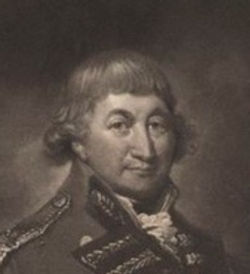
William Erskine
BIRTH
1728
unknown
DEATH
March 19, 1795
Fife, Scotland
FAMILY
##
Erskine, William
(1719-1795)
Lieutenant-General Sir William Erskine, 1st Baronet was a British Army commander and the 1st Baronet of the Erskine of Torrie creation.
3
WIFE

Henrietta Baillie
(1698-?)
WIFE
Magdalen Myrton
(1736-1757)
WIFE
Frances Moray
(1737-1793)
Sir William Erskine, 2nd Baronet
(1770-1813)
Frances Erskine
(1804-1830)
Places | Image | Address | GPS | Site |
|---|---|---|---|---|
Old South Meeting House | 310 Washington St, Boston, MA 02108 | MUSEUM | ||
Battle of Brooklyn Marker | Belt Parkway, New York, New York, 11209, USA | MARKER | ||
General William Erskine Long Island Headquarters Marker | 17 N Main St, Southampton, NY 11968 | MARKER |
DIED:
Fife, Scotland
Mar 19, 1795


Erskine joined his father's regiment the 7th Dragoons in 1742 and served in the War of the Austrian Succession, seeing action at the Battle of Fontenoy, then in the Seven Years' War. By March 1759 he was in Germany with the rank of major in the 15th Light Dragoons, and was promoted lieutenant-colonelcommanding the same regiment in 1762. Erskine performed exceptionally on the field at the Battle of Emsdorf and was able to present King George III with 16 colors captured by his regiment. For his prowess, Erskine was knighted.
Erskine was posted to America in 1776 as a brigadier staff officer under Clinton, seeing action in the New York campaignand commanding the 7th Brigade at Long Island 27 August 1776. In 1777 he was quartermaster-general to Lord Cornwallis. Erskine is credited with advising Cornwallis on the occasion of the Battle of the Assunpink Creek (also known as 'Five Mile Run') not to put off attacking the Continental Army on the night of 2 January 1777. The Continental forces moved away by night, fighting the Battle of Princeton on 3 January.
Erskine was made colonel of the 80th Foot on 4 March 1777. Now a brigadier-general, Erskine accompanied British forces as second in command under General William Tryon with the assistance of General James Agnew on an inland raid against Patriot supply depots in Danbury, Connecticut. After successfully destroying Patriot supplies, the British forces engaged and defeated Continental Army generals David Wooster, Benedict Arnold, and Gold S. Silliman and Patriot militiamen in the Battle of Ridgefield.
Erskine served in the Philadelphia campaign and then, following Sir William Howe's resignation in 1778, continued as quartermaster-general under Henry Clinton. Erskine went on to lead troops at the Battle of Monmouth and after that campaign was given command of the eastern district of Long Island. Erskine's last active duty in North America was commanding five infantry battalions and a cavalry squadron in pursuit of the Continental Army which was thought to be moving to Virginia in November 1778. Promoted major-general on 19 February 1779, Erskine sailed for London the same year.