

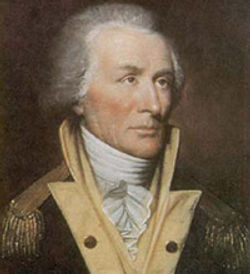
Thomas Sumter
BIRTH
Aug 14, 1734
Hanover County, Virginia
DEATH
June 1, 1832
Stateburg, South Carolina
FAMILY
##
Sumter, Thomas
(1734-1832)
Thomas Sumter was an American military officer, planter, and politician who served in the Continental Army as a brigadier-general during the Revolutionary War. After the war, Sumter was elected to the House of Representatives and to the Senate, where he served from 1801 to 1810, when he retired. Sumter was nicknamed the "Fighting Gamecock" for his military tactics during the Revolutionary War.

GRAVE:
MARKER
Thomas Sumter Memorial Park gravesite
General Thomas Sumter Memorial, Springbank Hills, SC, 29152, United States

5
Places | Image | Address | GPS | Site |
|---|---|---|---|---|
Battle of Hanging Rock Marker | 1801 Hanging Rock Rd, Kershaw, SC 29067 | PARK | ||
Huck's Defeat - Brattonsville | 1444 Brattonsville Rd, McConnells, SC 29726 | PARK | ||
Battle of Fishdam Ford Marker | West End Road, Chester County, South Carolina, 29031, USA | MARKER | ||
Battle of Fishing Creek Marker | 1236 Catawba River Rd, Great Falls, SC 29055 | MARKER | ||
Attack on Rocky Mount Marker | Catawba Road, Fairfield County, South Carolina, 29055, USA | MARKER |
DIED:
Stateburg, South Carolina
Jun 1, 1832


Thomas Sumter was born in Hanover County in the Colony of Virginia. His father, William Sumpter, was a miller and former indentured servant, while his mother, Elizabeth, was a midwife. His father was born in England, and Sumter was of English and Welsh descent. Most of Thomas Sumter's early years were spent tending livestock and helping his father at the mill, not in school. Given just a rudimentary education on the frontier, the young Sumter served in the Virginia militia, where he was present for Edward Braddock's defeat.
Sumter raised a local militia group in Stateburg. In February 1776, Sumter was elected lieutenant colonel of the Second Regiment of the South Carolina Line of which he was later appointed colonel. in 1780 he was appointed brigadier general, a post he held until the end of the war. He participated in several battles in the early months of the war, including the campaign to prevent an invasion of Georgia. Perhaps his greatest military achievement was his partisan campaigning, which contributed to Lord Cornwallis' decision to abandon the Carolinas for Virginia.
During fighting in August 1780, he defeated a combined force of Loyalists and British Army regulars at Hanging Rock, and intercepted and defeated an enemy convoy. Later, however, his regiment was almost annihilated by forces led by Banastre Tarleton. He recruited a new force, defeated Major James Wemyss in November, and repulsed an attack by Tarleton, in which he was wounded.
In 1781, in response to a low number of recruits, Sumter publicly implemented a bounty for Continental Army recruiters, which stipulated that anyone who managed to recruit a certain number of volunteers for the South Carolina Line would receive Loyalist-owned slaves as a reward. Sumter acquired the nickname "Carolina Gamecock" during the American Revolution, for his fierce fighting tactics. After the Battle of Blackstock's Farm, British Lieutenant Colonel Banastre Tarletoncommented that Sumter "fought like a gamecock", and Cornwallis described the Gamecock as his "greatest plague".