

Nicolaus Copernicus
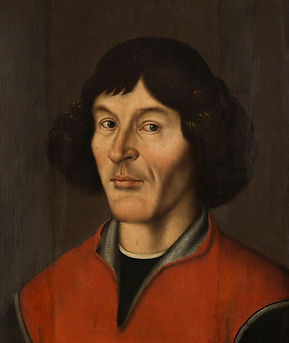
(1473-1543)
BIRTH
February 19, 1473
PLACE
Torun, Poland
DEATH
May 24, 1543
PLACE
Frombork, Poland
FAMILY

FATHER
Niklas Koppernigk
(birth date unknown; died between 1483 and 1485)
CHILDREN
Barbara Watzenrode
(birth date unknown; died circa or after 1495)
HOMES
POLITICAL VIEWS
CROWN AND PRUSSIA MONETARY UNIFICATION ADVOCATE, CURRENCY DEVALUATION OPPONENT
RELIGIOUS VIEWS
CHRISTIAN
CATHOLIC
MEMBERSHIPS
FROMBORK CATHEDRAL CHAPTER CANON
AWARDS
Nicolaus Copernicus (1473–1543) was a mathematician and astronomer who proposed that Earth rotates and travels around the Sun with the other planets. His On the Revolutions of the Heavenly Spheres appeared in 1543, presenting a systematic alternative to Earth-centered astronomy while retaining circular motions. Earlier publication by his pupil Rheticus helped introduce the theory. The model remained controversial but became a foundation for later changes in astronomy.
EARLY LIFE
Nicolaus Copernicus was born on February 19, 1473, in Toruń, in Royal Prussia under the Polish crown, the youngest of four children of Nicolaus Copernicus, a copper merchant, and Barbara Watzenrode. After his father's death around 1483, he was raised by his maternal uncle Lucas Watzenrode, who later became bishop of Warmia. In 1491 he entered the University of Kraków, where he studied astronomy and mathematics. In 1496 he went to Italy, studying canon law at Bologna, where he assisted the astronomer Domenico Maria Novara, and medicine at Padua. He received a doctorate in canon law from the University of Ferrara in 1503.
Nicolaus Copernicus combined astronomical research with duties as a cathedral canon in Warmia. His ecclesiastical position provided income while requiring administrative work, medical service, and involvement in local politics. He served his uncle, Bishop Lucas Watzenrode, as secretary and physician before settling at Frombork. Management of chapter estates and disputes occupied much of his time; during war with the Teutonic Knights, he helped organize the defense of Olsztyn. He also wrote proposals for monetary reform, arguing against debasement of currency.
Around 1510–1514 he circulated the Commentariolus, a short manuscript proposing that Earth rotated daily and traveled annually around the Sun. The arrangement offered a connected explanation of planetary order and apparent backward motion. Copernicus was concerned with the mathematical consistency of earlier astronomy, particularly devices that did not preserve uniform circular movement. His model retained circles and subsidiary circles; it was not the later system of elliptical orbits developed by Kepler.
Over decades he refined calculations, compared astronomical traditions, and prepared On the Revolutions of the Heavenly Spheres. In 1539 the mathematician Georg Joachim Rheticus came to study with him. Rheticus published an introductory account and helped persuade him to print the larger work. Published at Nuremberg in 1543 and dedicated to Pope Paul III, the book presented a detailed mathematical astronomy organized around Earth's motion. Andreas Osiander added an unsigned introductory statement treating the system as a calculating hypothesis; that statement did not accurately express Copernicus's own claim about the world's arrangement.
Copernicus died in 1543, traditionally said to have received the printed book shortly before death. Reception was gradual: some readers used his calculations without accepting a moving Earth, while others developed the physical implications of his theory. His work later became central to controversies involving Galileo and was placed under restrictions by the Catholic Church in 1616, long after his death. The astronomical transformation also drew on earlier Greek and Islamic mathematical work, and historians debate particular lines of transmission. His achievement was to offer a coherent alternative to geocentric planetary organization, initiating changes that later observations and theories substantially revised.
CAREER
DEATH
Toward the close of 1542, Copernicus was seized with apoplexy and paralysis, and he died at age 70 on 24 May 1543. Legend has it that he was presented with the final printed pages of his Dē revolutionibus orbium coelestium on the very day that he died, allowing him to take farewell of his life's work. He is reputed to have awoken from a stroke-induced coma, looked at his book, and then died peacefully. Copernicus was reportedly buried in Frombork Cathedral, where a 1580 epitaph stood until being defaced; it was replaced in 1735. For over two centuries, archaeologists searched the cathedral in vain for Copernicus's remains. Efforts to locate them in 1802, 1909, 1939 had come to nought. In 2004 a team led by Jerzy Gąssowski, head of an archaeology and anthropology institute in Pułtusk, began a new search, guided by the research of historian Jerzy Sikorski. In August 2005, after scanning beneath the cathedral floor, they discovered what they believed to be Copernicus's remains. The discovery was announced only after further research, on 3 November 2008. Gąssowski said he was "almost 100 percent sure it is Copernicus". Forensic expert Capt. Dariusz Zajdel of the Polish Police Central Forensic Laboratory used the skull to reconstruct a face that closely resembled the features—including a broken nose and a scar above the left eye—on a Copernicus self-portrait. The expert also determined that the skull belonged to a man who had died around age 70—Copernicus's age at the time of his death.
Frombork Cathedral
Cathedral Hill, 14-530 Frombork, Poland

GRAVE
POPULAR BIOGRAPHIES
1. A More Perfect Heaven: How Copernicus Revolutionized the Cosmos — Dava Sobel. Find on Amazon
2. Nicolaus Copernicus: Making the Earth a Planet — Owen Gingerich and James MacLachlan. [Biography for younger readers] Find on Amazon
3. The Life of Copernicus, 1473–1543 — Pierre Gassendi; Olivier Thill (translator). [Early biography] Find on Amazon
4. Copernicus and the Aristotelian Tradition: Education, Reading, and Philosophy in Copernicus's Path to Heliocentrism — André Goddu. [Intellectual biography] Find on Amazon
5. The Book Nobody Read: Chasing the Revolutions of Nicolaus Copernicus — Owen Gingerich. [Study of his book and its reception] Find on Amazon
103398