

Isaac Newton
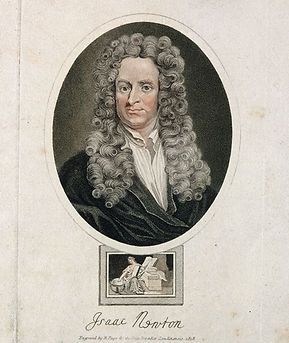
(1643-1727)
BIRTH
January 4, 1643
PLACE
Woolsthorpe-by-Colsterworth, England
DEATH
March 31, 1727
PLACE
London, England
FAMILY

FATHER
Isaac Newton Sr.
(c. 1606–1642)
MOTHER
Hannah Ayscough
(died 1679)
HOMES
RELIGIOUS VIEWS
CHRISTIAN, RELIGIOUS DISSENTER
DENOMINATION UNCERTAIN
MEMBERSHIPS
FELLOW OF THE ROYAL SOCIETY, ROYAL SOCIETY PRESIDENT, SOCIETY PRESIDENT
AWARDS
English mathematician and physicist Isaac Newton formulated the laws of motion and universal gravitation in the Principia, co-invented calculus, and advanced the study of optics. Newton became Lucasian Professor of Mathematics at Cambridge in 1669. He developed calculus independently of Gottfried Wilhelm Leibniz, and a bitter dispute over priority followed. His Opticks was published in 1704. He also wrote extensively on alchemy and biblical chronology.
EARLY LIFE
Isaac Newton was born on January 4, 1643, at Woolsthorpe Manor near Colsterworth, Lincolnshire, by the New Style calendar, or on Christmas Day 1642 by the Julian calendar then used in England. His father, a farmer also named Isaac, died three months before his birth. When his mother, Hannah Ayscough, remarried, he was left in the care of his grandmother. He attended The King's School in Grantham, and after his mother tried to make him a farmer, he returned to school and entered Trinity College, Cambridge, in 1661. While the university was closed by plague in 1665 and 1666, he worked at Woolsthorpe on calculus, optics, and gravitation.
Isaac Newton's research developed at Cambridge and during periods away from the university in the plague years of the 1660s. Work on series, rates of change, light and motion supplied foundations for later publications. He became Lucasian professor in 1669 and constructed a reflecting telescope that helped bring him to the Royal Society's attention. His prism experiments argued that white light contains different colours rather than acquiring colour through modification by glass. Debate with Robert Hooke and other investigators made the interpretation of experiment and the management of criticism recurring concerns.
With Edmond Halley's encouragement and assistance, Newton published the Principia in 1687. Its laws of motion and universal gravitation provided a mathematical framework connecting terrestrial movement with planetary orbits. The achievement involved demonstrating relationships and explaining observations, not merely proposing attraction. Questions about the physical cause of gravity remained unresolved. He also developed methods now associated with calculus independently of Gottfried Wilhelm Leibniz. The later priority dispute became bitter, and Newton used his institutional influence in ways that compromised the apparent neutrality of the Royal Society's investigation.
Newton's Opticks, published in 1704, presented experimental work and speculative questions about light and matter. His alchemy, theology and chronology also formed important parts of his intellectual world. Much of this writing remained unpublished during his lifetime. He served briefly in Parliament and moved to London in 1696 as warden of the Royal Mint, where the Great Recoinage required intensive administration. Investigating counterfeiters and supervising currency production formed substantial professional work, not just an honorary reward for scientific achievement.
He became master of the Mint in 1699 and remained in office until his death. Elected president of the Royal Society in 1703 and knighted in 1705, he exercised considerable authority over British scientific life. Disputes with the astronomer John Flamsteed over observations illustrate both his reliance on others' data and the tensions surrounding control of it. Revised editions of the Principia extended and refined the original work. He died in 1727 and was buried in Westminster Abbey. His mathematical physics transformed later science, while his manuscripts reveal broader and often contentious interests.
CAREER
DEATH
Newton died in his sleep in London on 20 March 1727 (NS 31 March 1727), aged 84. Newton was given a state funeral—the first in England for someone recognized primarily for intellectual achievement. The Lord Chancellor, two dukes, and three earls bore his pall, with most of the Royal Society following. His body lay in state in Westminster Abbey for eight days before burial in the nave. Newton was the first scientist to be buried in the abbey. Voltaire may have been present at his funeral. Newton's death received sizable attention in the contemporary press. Several gazettes announced his death, while The Political State of Great Britain devoted three pages to praising his achievements and described him as "the greatest of Philosophers, and the Glory of the British Nation." Poet James Thomson's "Poem Sacred to the Memory of Sir Isaac Newton" also went through five editions before the end of the year. A bachelor, he had divested much of his estate to relatives during his last years, and died intestate. His papers went to John Conduitt and Catherine Barton. Shortly after his death, a plaster death mask was moulded of Newton. It was used by the Flemish sculptor John Michael Rysbrack in making a sculpture of Newton. It is now held by the Royal Society. Newton's hair was posthumously examined and found to contain mercury, probably resulting from his alchemical pursuits. Mercury poisoning could explain Newton's eccentricity in late life.
Westminster Abbey
20 Dean's Yard, City of Westminster, SW1P 3PA, United Kingdom

GRAVE

POPULAR BIOGRAPHIES
1. Never at Rest: A Biography of Isaac Newton — Richard S. Westfall. Find on Amazon
2. Isaac Newton — James Gleick. Find on Amazon
3. Isaac Newton: The Last Sorcerer — Michael White. Find on Amazon
4. A Portrait of Isaac Newton — Frank E. Manuel. Find on Amazon
5. Priest of Nature: The Religious Worlds of Isaac Newton — Rob Iliffe. [Intellectual and religious biography] Find on Amazon
102993