

Locust Grove Marker
156 Clayton Manor Drive, New Castle County, Delaware, 19709, USA
Delaware, USA

MARKER
TICKETED:
NO
PARKING:
NO
RESTROOMS:
NO
HOME
1783
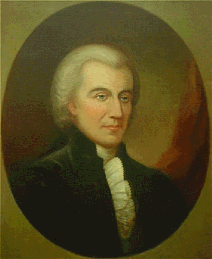
Clayton, Joshua
HISTORIC PEOPLE WHO WERE HERE
1
HISTORIC PRESERVATION at Locust Grove Marker.
his home was once the residence of Joshua Clayton (1744-1798), an eminent physician and distinguished government leader in post-Revolutionary Delaware. After attending the University of Pennsylvania he established a successful local practice and was later one of the founders of the Medical Society of Delaware. At the outset of the Revolution he was commissioned as an officer in the Bohemia Manor Militia. Clayton's career as a statesman began with his election to the Delaware House of Assembly in 1783. He was subsequently chosen to serve as State Treasurer in 1786, and in 1789 he was elected by the legislature to the office of "President," or chief executive of Delaware. He was the last person to hold that title under the State Constitution of 1776. A new frame of government was adopted in 1792, and in October of that year Delawareans went to the polls to cast their ballots. With his election, Joshua Clayton became the State's first popularly elected chief executive, and the first to hold the title of "Governor."
About Locust Grove Marker
Locust Grove is associated with Delaware’s colonial and Revolutionary-era rural landscape. Farms like this produced grain, livestock, and forage needed by civilians and military forces, while local owners faced wartime taxation and requisitions. No specific battle, headquarters, or documented troop encampment at the property is established here.
HISTORY HAPPENED HERE at Locust Grove Marker
Locust Grove became the home of Dr. Joshua Clayton, a physician and important Delaware statesman. During the Revolution Clayton served with American forces, and his medical training was valuable in a war where disease killed more soldiers than combat. He later entered state government, served as president and then governor of Delaware, and represented the state in the United States Senate. His career illustrates the movement of Revolutionary veterans into civil administration and the effort to build stable institutions after independence.
his home was once the residence of Joshua Clayton (1744-1798), an eminent physician and distinguished government leader in post-Revolutionary Delaware.
The event took place within a landscape where roads, bridges, rivers, taverns, farms, workshops, and private houses performed public functions. Military and political leaders depended on printers, laborers, servants, enslaved people, sailors, teamsters, messengers, militia, and local families. Their contributions and losses are often compressed into a marker's brief wording. Examining the location restores the practical scale of movement, supply, communication, and coercion that shaped the Revolution and the early republic.
Although the original structures or terrain may have changed, the marker fixes the history to a specific point. It encourages visitors to compare concise commemoration with the fuller documentary record and to consider how later generations selected events for remembrance. The site's value lies not only in its association with a famous person or date, but also in the way local geography and community resources influenced decisions with consequences far beyond the immediate neighborhood. Seen in broader context, this place demonstrates how large historical outcomes emerged from local choices, routes, resources, conflicts, and acts of endurance. The surviving location gives those relationships a tangible human scale. Seen in broader context, this place demonstrates how large historical outcomes emerged from local choices, routes, resources, conflicts, and acts of endurance. The surviving location gives those relationships a tangible human scale. Seen in broader context, this place demonstrates how large historical outcomes emerged from local choices, routes, resources, conflicts, and acts of endurance. The surviving location gives those relationships a tangible human scale. Seen in broader context, this place demonstrates how large historical outcomes emerged from local choices, routes, resources, conflicts, and acts of endurance. The surviving location gives those relationships a tangible human scale. Seen in broader context, this place demonstrates how large historical outcomes emerged from local choices, routes, resources, conflicts, and acts of endurance. The surviving location gives those relationships a tangible human scale.
HISTORIC PLACES NEARBY
10 Pie Recipes to Try This Fall
####.## MI

MONUMENT
10 Pie Recipes to Try This Fall
10 Pie Recipes to Try This Fall
10 Pie Recipes to Try This Fall
10 Pie Recipes to Try This Fall
10 Pie Recipes to Try This Fall
10 Pie Recipes to Try This Fall
10 Pie Recipes to Try This Fall
10 Pie Recipes to Try This Fall
10 Pie Recipes to Try This Fall
10 Pie Recipes to Try This Fall
10 Pie Recipes to Try This Fall
10 Pie Recipes to Try This Fall
EXTERNAL LINKS