

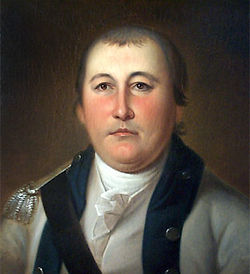
William Washington
BIRTH
Feb 28, 1752
Stafford County, Virginia
DEATH
March 6, 1810
Charleston County, South Carolina
FAMILY
FATHER:

Bailey Washington
(1730-1807)
##
Washington, William
(1752-1810)
William Washington was a cavalry officer of the Virginia militia and Continental Army during the American Revolutionary War, who also served on General George Washington's staff during the naval war with France in 1798 and held a final rank of brigadier general.
GRAVE:
MARKER
Grave of William Washington
3998 Waldon Road, Hollywood, South Carolina, 29470, USA

7
WIFE
Jane Reily Elliott Washington
(1763-1830)
Places | Image | Address | GPS | Site |
|---|---|---|---|---|
Valley Forge National Historic Park | 1400 N Outer Line Dr, King of Prussia, PA 19406 | MUSEUM | ||
George Washington's Mount Vernon | 3200 Mount Vernon Memorial Hwy, Mt Vernon, VA 22121 | MUSEUM | ||
Colonial Williamsburg | 101 Visitor Center Dr, Williamsburg, VA 23185 | MUSEUM | ||
Guilford Courthouse National Military Park | 2332 New Garden Rd, Greensboro, NC 27410 | MUSEUM | ||
Washington's Crossing State Park | 355 Washington Crossing Pennington Rd, Titusville, NJ 08560 | MUSEUM | ||
Washington's Crossing Historic Park | 1112 River Rd, Washington Crossing, PA 18977 | MUSEUM | ||
Grave of William Washington | 3998 Waldon Road, Hollywood, South Carolina, 29470, USA | MARKER |
DIED:
Charleston County, South Carolina
Mar 6, 1810


Born in Stafford County, Virginia, William was the second son of Bailey Washington and Catherine (née Storke) Washington. Correspondence between William and George Washington, first President of the United States, indicates William and George were second cousins once removed. William received an education appropriate to his Southern slaveowning planter class, including tutoring from Reverend Dr. William Stuart, a Virginia clergyman. William learned the Greek language and may have studied theology for a potential career in the church.
On January 27, 1777, William was promoted to the rank of major and assigned to the newly created 4th Continental Light Dragoons. In the fall of 1778, he was assigned to the 3rd Continental Light Dragoons, which was severely mauled in a surprise attack on the night of September 27 at Old Tappan, New Jersey, by a force of British light infantry. Only 55 of the lightly armed dragoons escaped the attack and their commander, Lt. Col. George Baylor, was wounded and captured. Washington was promoted to lieutenant colonel and placed in command of the 3rd Light Dragoons on November 20, 1778. Washington's unit spent the summer of 1779 recruiting and remounting. On November 19, 1779, his unit was transferred to the war's Southern theater, and marched to join the army of Major General Benjamin Lincoln in Charleston, South Carolina.
On March 10, 1780, Washington's regiment joined forces with the remnants of the 1st Continental Light Dragoons at Bacon's Bridge, South Carolina, to reconnoiter and screen against the advancing British. On March 26, his first encounter with the British Legion, under command of Lieutenant Colonel Banastre Tarleton, resulted in a minor victory near Rantowle's Bridge on the Stono River in South Carolina. Afterward, on the Ashley River during the fight at Rutledge's Plantation on March 26, 1780, Lt. Col. Washington again bested a detachment of Tarleton's dragoons and infantry. Tarleton, however, attacked the encampment of General Isaac Huger at Monck's Corner on the night of April 14, 1780, and routed the Continentals, including the 3rd Light Dragoons, which lost 15 dead, 17 wounded, and 100 dragoons captured, along with 83 horses.
Washington and his remaining troops fled across the Santee River to escape capture. The severe attrition of Washington's command forced its amalgamation with the 1st Continental Light Dragoons under Lt. Col. Anthony Walton White. This force was defeated at Lenud's Ferry, waiting to cross the flooded Santee, on May 6, 1780. White was captured and Washington assumed command of the 1st-and-3rd Dragoons. The force withdrew to North Carolina when Lincoln surrendered the southern army and Charleston on May 12.