

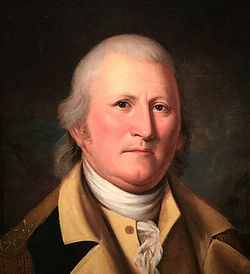
William Moultrie
BIRTH
Nov 23, 1730
Charleston, South Carolina
DEATH
September 27, 1805
Charleston, South Carolina
FAMILY
##
Moultrie, William
(1730-1805)
William Moultrie was an American slave owning planter and politician who became a general in the American Revolutionary War. As colonel leading a state militia, in 1776 he prevented the British from taking Charleston, and Fort Moultrie was named in his honor.

GRAVE:
MARKER
Grave of William Moultrie
1214 Middle St, Sullivan's Island, SC 29482

3
Places | Image | Address | GPS | Site |
|---|---|---|---|---|
Fort Moultrie National Historic Park | 1214 Middle St, Sullivan's Island, SC 29482 | MUSEUM | ||
Battle of Port Royal Island Marker | Parker Drive, Beaufort County, South Carolina, 29906, USA | MARKER | ||
Grave of William Moultrie | 1214 Middle St, Sullivan's Island, SC 29482 | MARKER |
DIED:
Charleston, South Carolina
Sep 27, 1805


William Moultrie was born in Charles Town in the Province of South Carolina. His parents were the Scottish physician Dr. John Moultrie and Lucretia Cooper, and he acquired a slave plantation, enslaving over 200 African Americans. Moultrie fought in the Anglo-Cherokee War (1761). Before the advent of the American Revolution, he was elected to the colonial assembly representing St. Helena Parish. In 1775, Moultrie was commissioned as colonel of the 2nd South Carolina Regiment of provincial troops.
In 1776, Moultrie's defense of a small fort on Sullivan's Island (later named Fort Moultrie in his honor) prevented Sir Henry Clinton and Sir Peter Parker from taking Charleston. The Continental Congress passed a resolution thanking Moultrie. He was promoted to brigadier general and his regiment was taken into the Continental Army.
Moultrie successfully led a repulse of the British at Port Royal in February 1779. That spring when Maj. Gen. Benjamin Lincoln took the bulk of the American force towards Augusta, Georgia, Moultrie was stationed at Black Swamp with a small contingent to watch the British on the other side of the Savannah River. When the British suddenly crossed the Savannah en masse and tried to move on Charleston, Moultrie managed a skillful tactical retreat across the Coosawhatchie and the Tullifiny Rivers and all the way back to Charleston where he held off a short siege. He refused to surrender at a time when the civilian authorities in Charleston felt somewhat abandoned by the Continental Congress and were almost ready to give up.
Moultrie was captured when Charleston surrendered to the British in 1780. He was left in command of the American POWs which required all of the patience and skill of a diplomat when advocating for his men against the harsh British commandant, Lt. Col. Nisbet Balfour. The British also attempted to lure him to their side, and he was absolutely indignant when he was approached by Charles Greville Montague. Moultrie was exchanged for British prisoners in 1782. The same year, he was promoted to major general, the last man appointed by Congress to that rank.