

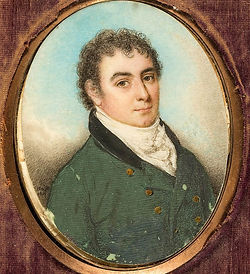
Thomas Boylston Adams
BIRTH
Sep 15, 1772
Braintree, Massachusetts
DEATH
March 13, 1832
Quincy, Massachusetts
FAMILY
FATHER:

John Adams
(1735-1826)
MOTHER:

Abigail Adams
(1744-1818)
##
Adams, Thomas Boylston
(1772-1832)
Thomas Boylston Adams was the third and youngest son of second United States president John Adams and Abigail (Smith) Adams. He worked as a lawyer, a secretary to his brother John Quincy Adams while the latter served as United States ambassador to the Netherlands and Prussia, the business manager of and a contributor to the political and literary journal Port Folio, and a Massachusetts chief justice.

BIRTHPLACE:
MUSEUM
John Quincy Adams Birthplace
133 Franklin St, Quincy, MA 02169

2
BROTHER

John Adams Sr.
(1691-1761)
BROTHER

Charles Adams
(1770-1800)
SISTER

Abigail "Nabby" Adams Smith
(1765-1813)
BROTHER

John Quincy Adams
(1767-1848)
WIFE
Ann Harrod
(1774-1845)
Abigail Adams Angier
(1806-1845)
Elizabeth Coombs Adams
(1808-1903)
Places | Image | Address | GPS | Site |
|---|---|---|---|---|
John Adams Peacefield | 1250 Hancock St, Quincy, MA 02169 | MUSEUM | ||
John Quincy Adams Birthplace | 133 Franklin St, Quincy, MA 02169 | MUSEUM |
DIED:
Quincy, Massachusetts
Mar 13, 1832


Thomas Boylston Adams was born on September 15, 1772, in Braintree, Massachusetts, the youngest son of John Adams and Abigail Smith Adams. His brothers and sister were Abigail “Nabby,” John Quincy, Charles, and the deceased infant Susanna. Thomas entered a household unusually devoted to education, public service, correspondence, and the Patriot cause. His father’s political work frequently kept him away, making Abigail the central authority of the children’s early lives. Thomas spent part of childhood at the family farm while war and diplomacy scattered the household. Abigail supervised reading, religion, farm responsibilities, and moral conduct. The Adams children were expected to treat privilege as an obligation to cultivate knowledge and character. Letters from both parents combined affection with exacting criticism. Unlike John Quincy, Thomas did not accompany his father on early diplomatic missions. He was educated in Massachusetts and attended Harvard College, graduating in 1790. Harvard’s curriculum emphasized classics, rhetoric, logic, mathematics, theology, and preparation for law or government. Thomas then studied law and was admitted to the bar. His early adulthood remained closely tied to family expectations. He traveled to Europe and served as secretary to John Quincy Adams during diplomatic assignments at The Hague and Berlin. This work provided training in languages, correspondence, protocol, and international politics but also kept him within the shadow of a highly accomplished brother and father. Before becoming a judge and local public figure, Thomas had been shaped by Revolutionary-era separation, a formidable mother, an often-absent statesman father, Harvard education, legal preparation, and diplomatic travel. The Adams family’s intensity could inspire achievement but also impose emotional pressure. Thomas’s later struggles with alcohol and uneven professional success should not obscure the advantages and burdens of this upbringing. He belonged to the first American generation raised with the explicit expectation of preserving a family tradition of republican leadership.
The available biographical record identifies Thomas Boylston Adams with work or public activity as a lawyer, judge. Those roles provide the clearest documented basis for including this person in the database and should be read in the political, military, professional, or household context of the period. Thomas Boylston Adams died on Mar 13, 1832 in Quincy, Massachusetts. Additional claims about employment, public service, or accomplishments have been omitted where the consulted source did not support them.