

Peter the Great
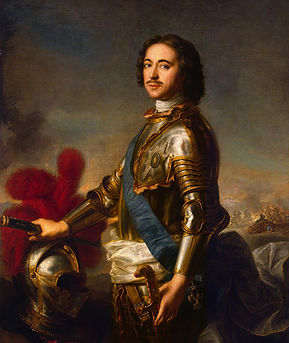
(1672-1725)
BIRTH
June 9, 1672
PLACE
Moscow, Russia
NAME
Pyotr Alekseyevich
DEATH
February 8, 1725
PLACE
Saint Petersburg, Russia
FAMILY

FATHER
Alexis of Russia
(1629–1676)
MOTHER
Natalya Naryshkina
(1651–1694)
WIFE
Eudoxia Lopukhina
(1669-1731)
WIFE
Catherine I of Russia
(1684-1727, second wife of Peter the Great, later Empress)
HOMES
NICKNAMES
the Great
POLITICAL VIEWS
STATE CONTROL OF CHURCH ADVOCATE, WESTERNIZATION ADVOCATE
RELIGIOUS VIEWS
CHRISTIAN
RUSSIAN ORTHODOX
MEMBERSHIPS
AWARDS
ORDER OF SAINT ANDREW RECIPIENT, ORDER OF THE ELEPHANT RECIPIENT
Peter the Great, tsar and then first emperor of Russia, modernized the country along Western lines, built a navy, defeated Sweden in the Great Northern War, and founded Saint Petersburg. In 1689 he married Eudoxia Lopukhina and took power from Sophia. After Ivan's death in 1696, Peter ruled alone. In 1703 he founded Saint Petersburg on the Baltic, which became the capital. He created the Table of Ranks and placed the church under a Holy Synod.
EARLY LIFE
Pyotr Alekseyevich was born on June 9, 1672, in Moscow, the son of Tsar Alexis and his second wife, Natalya Naryshkina. His father died in 1676, and in 1682 Peter was proclaimed co-tsar with his half-brother Ivan V under the regency of their sister Sophia, after a bloody uprising of the streltsy musketeers that he witnessed as a boy. He spent much of his youth at the village of Preobrazhenskoye outside Moscow, where he organized play regiments of boys that later became elite guards units, and learned sailing and shipbuilding from foreigners in Moscow's German Quarter. In 1689 he married Eudoxia Lopukhina and took power from Sophia.
Peter became a Russian tsar in 1682, initially sharing the title with his half-brother Ivan V while their sister Sophia exercised the regency. He displaced Sophia in 1689 and became sole ruler after Ivan's death in 1696. Military experimentation, shipbuilding and contact with foreign specialists shaped his approach to government. Campaigns against the Ottoman Empire secured Azov in 1696, encouraging his ambition to establish a navy and obtain access to international sea routes. On the Great Embassy of 1697–1698 he travelled in western Europe to seek allies and learn about naval and industrial techniques.
Peter redirected Russia's principal military effort toward Sweden in the Great Northern War, which began in 1700. Defeat at Narva exposed weaknesses in the army, but he rebuilt its organization, expanded armaments production and imposed heavy demands for recruits and revenue. In 1703 he founded St Petersburg on territory seized near the Baltic, making it both a strategic port and a new centre of royal power. His victory over Charles XII at Poltava in 1709 changed the balance of the war. The Treaty of Nystad in 1721 confirmed major Baltic acquisitions, and Peter adopted the title emperor. A separate Ottoman campaign ended badly in 1711 and cost him Azov.
His reforms sought a stronger, more service-oriented state. He established the Senate, reorganized central administration into colleges, promoted technical education and encouraged foreign expertise. The Table of Ranks, introduced in 1722, linked official standing to military and civil service, while still operating within a deeply unequal society. A poll tax supported the expanding army and administration. He also reshaped elite dress and court customs. After the patriarchate's vacancy, he placed church administration under a Holy Synod in 1721, strengthening the monarchy's control over religious institutions.
The reforms depended on coercion as well as innovation. Taxation, conscription and forced labour imposed severe burdens, on peasants; resistance met punishment. Peter suppressed the streltsy revolt of 1698 and later prosecuted his son Alexei, who died in custody in 1718. His final campaigns added territories along the Caspian, although these gains proved less durable than the Baltic settlement. At his death in 1725 he left Russia with enlarged military power, a new capital and altered governing institutions, together with the social costs of an intensely autocratic transformation.
CAREER
DEATH
In the summer of 1724, a team of doctors performed surgery releasing upwards of four pounds of blocked urine. Peter remained bedridden until late autumn. In the first week of October, restless and certain he was cured, Peter began a lengthy inspection tour of various projects. Rastrelli finished his monument to Peter I. According to legend, in November, at Lakhta along the Gulf of Finland to inspect some ironworks, Peter saw a group of soldiers drowning near shore and, wading out into near-waist deep water, came to their rescue. This icy water rescue is said to have exacerbated Peter's bladder problems and caused his death. The story, however, has been viewed with skepticism by some historians, pointing out that the German chronicler is the only source for the story. In early January 1725, Peter was struck once again with uremia or azotemia. Legend has it that before lapsing into unconsciousness Peter asked for a paper and pen and scrawled an unfinished note that read: "Leave all to..." and then, exhausted by the effort, asked for his daughter Anna to be summoned. Peter died between four and five in the morning 8 February. An autopsy revealed his bladder to be infected with gangrene. He was fifty-two years, seven months old when he died, having reigned forty-two years. He is interred in Saints Peter and Paul Cathedral. After his death, students came to the Military College with a request to "leave science" under the pretext of "unconsciousness and incomprehensibility."
Peter and Paul Cathedral
Peter and Paul Fortress, Building 3, Saint Petersburg, Russia

GRAVE
POPULAR BIOGRAPHIES
1. Peter the Great: His Life and World — Robert K. Massie. Find on Amazon
2. Russia in the Age of Peter the Great — Lindsey Hughes. [Study of his reign] Find on Amazon
3. Peter the Great — Paul Bushkovitch. Find on Amazon
4. Peter the Great: A Biography — Lindsey Hughes. Find on Amazon
5. Peter the Great — Derek Wilson. Find on Amazon
102725