

Mikhail Gorbachev
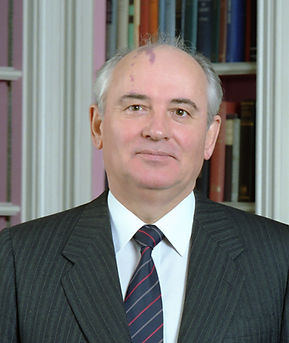
(1931-2022)
BIRTH
March 2, 1931
PLACE
Privolnoye, Russia
NAME
Mikhail Sergeyevich Gorbachev
DEATH
August 30, 2022
PLACE
Moscow, Russia
FAMILY

FATHER
Sergey Andreyevich Gorbachev
(1909–1976)
MOTHER
Maria Panteleyevna Gorbacheva
(1911–1995)
WIFE
Raisa Gorbacheva
(1932-1999)
CHILDREN
Sergey Andreyevich Gorbachev
(1909–1976)
HOMES
NICKNAMES
Gorby
POLITICAL VIEWS
COMMUNIST
COMMUNIST PARTY OF THE SOVIET UNION MEMBER
RELIGIOUS VIEWS
ATHEIST
NO DENOMINATIONAL AFFILIATION
MEMBERSHIPS
KOMSOMOL MEMBER
AWARDS
NOBEL PEACE PRIZE RECIPIENT, ORDER OF THE RED BANNER OF LABOUR RECIPIENT
Mikhail Gorbachev, the last leader of the Soviet Union, introduced glasnost and perestroika, ended the Cold War, and received the 1990 Nobel Peace Prize before the Soviet Union dissolved in 1991. He moved to Moscow in 1978 to oversee agriculture and joined the Politburo in 1980. On March 11, 1985, he was chosen general secretary of the Communist Party. Nationalist movements and economic crisis weakened the union. He died in Moscow on August 30, 2022.
EARLY LIFE
Mikhail Sergeyevich Gorbachev was born on March 2, 1931, in Privolnoye, in the Stavropol region of southern Russia, into a peasant family of Russian and Ukrainian descent. His childhood was marked by collectivization and famine, and by the German occupation of the region during the Second World War. As a teenager he worked with his father on a combine harvester and in 1949 received the Order of the Red Banner of Labour for a record harvest. He studied law at Moscow State University, graduating in 1955, and there he met Raisa Titarenko, whom he married in 1953. He joined the Communist Party in 1952.
Mikhail Gorbachev built his career in the Communist Party and youth organization in the Stavropol region. He became regional first secretary in 1970, moved to Moscow as a Central Committee secretary responsible for agriculture in 1978, and joined the Politburo in 1980. Selected general secretary in March 1985, he inherited economic stagnation, an expensive military rivalry, and a political system resistant to change. He initially sought renewal of socialism rather than the dissolution of the Soviet state.
Gorbachev promoted perestroika, or restructuring, and glasnost, greater openness in public discussion. Economic reforms loosened some central controls without establishing a stable replacement, while reduced censorship exposed past repression and current failures. Political changes introduced competitive elections for the Congress of People's Deputies in 1989. In 1990 he became the Soviet Union's first executive president and supported ending the Communist Party's constitutional monopoly. These policies widened debate but also weakened institutions through which the central government had exercised authority.
His foreign policy reduced confrontation with the West. Negotiations with Ronald Reagan produced the Intermediate-Range Nuclear Forces Treaty in 1987. Soviet forces withdrew from Afghanistan, and Gorbachev declined to use military power to stop the collapse of Communist governments in Eastern Europe in 1989. He accepted German reunification and received the Nobel Peace Prize in 1990.
Within the Soviet Union, shortages, competing reform plans, and nationalist movements intensified the crisis. Violence in several republics and efforts to preserve central control complicated his reforming reputation. Conservative officials attempted a coup in August 1991, placing him under confinement in Crimea. The coup failed, but Boris Yeltsin and the republics gained power at his expense. Gorbachev resigned on December 25 as the Soviet Union ceased to exist. He later founded organizations devoted to political discussion and environmental causes, published books, and unsuccessfully contested the Russian presidency in 1996. He died in 2022. His career is assessed differently by those who emphasize political freedom and peaceful international change and those who associate his leadership with economic insecurity and the loss of a state. His central achievement and dilemma lay in initiating reforms whose consequences exceeded his intended control.
CAREER
DEATH
Mikhail Gorbachev died at Moscow's Central Clinical Hospital on August 30, 2022, aged 91. The hospital announced that he had died after a severe and prolonged illness, a broad description that did not publicly establish one precise immediate cause. Reports of his later health include serious diabetes and repeated medical treatment, but those conditions should not automatically be substituted for a documented final diagnosis. His last years had been spent largely outside direct political power, with increasingly limited public appearances as his physical condition weakened. He had survived his wife, Raisa, by more than two decades and was buried beside her in Moscow's Novodevichy Cemetery. The public farewell took place on September 3, with many mourners viewing his body at the House of Unions. The ceremony and debate over his legacy attracted extensive attention, yet they do not supply missing medical details. A responsible narrative describes a long period of ill health and a final hospital death, while retaining the uncertainty of the official wording. It does not invent a daily clinical decline, a specific infection or final conversations that the consulted biography does not document.
Novodevichy Cemetery
Luzhnetsky proezd 2, Moscow, Russia

GRAVE
POPULAR BIOGRAPHIES
1. Gorbachev: His Life and Times — William Taubman. Find on Amazon
2. The Gorbachev Factor — Archie Brown. [Political biography] Find on Amazon
3. Gorbachev — Zhores A. Medvedev. Find on Amazon
4. Gorbachev: Heretic in the Kremlin — Dusko Doder and Louise Branson. Find on Amazon
5. Gorbachev: The Man and the System — Ilya Zemtsov and John Farrar. Find on Amazon
102338