

John Calvin
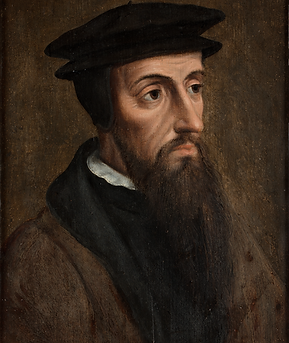
(1509-1564)
BIRTH
July 10, 1509
PLACE
Noyon, France
DEATH
May 27, 1564
PLACE
Geneva, Switzerland
FAMILY

FATHER
Gérard Cauvin
(birth date unknown)
WIFE
Idelette Calvin
(d. 1549)
HOMES
POLITICAL VIEWS
ARISTOCRATIC GOVERNMENT ADVOCATE, MAGISTRATE RESISTANCE TO TYRANNY ADVOCATE
RELIGIOUS VIEWS
CHRISTIAN
REFORMED CHRISTIAN
MEMBERSHIPS
AWARDS
French theologian John Calvin led the Reformation in Geneva, and his Institutes of the Christian Religion shaped Reformed and Presbyterian churches worldwide. In 1536 Calvin published the first edition of the Institutes of the Christian Religion in Basel. He preached, lectured, and wrote commentaries on most books of the Bible. In 1553 he supported the trial of Michael Servetus, who was burned for heresy. He died in Geneva on May 27, 1564.
EARLY LIFE
Jean Cauvin was born on July 10, 1509, in Noyon in Picardy, France, the son of Gérard Cauvin, a lawyer who served the cathedral chapter, and Jeanne le Franc. His father intended him for the priesthood and obtained church benefices to pay for his education. Around 1523 he went to Paris, studying at the Collège de la Marche and the Collège de Montaigu. His father later directed him to study law, and he studied at Orléans and Bourges, where he also learned Greek. In the early 1530s he experienced a conversion to Protestant ideas, and in 1533 he fled Paris after a friend's speech calling for reform provoked a crackdown.
John Calvin moved from legal and humanist studies into Protestant reform during the early 1530s. His first edition of the Institutes of the Christian Religion appeared at Basel in 1536, presenting a systematic defense and explanation of reforming Christian beliefs. Traveling through Geneva that year, he was persuaded by William Farel to remain and help organize the church. Conflict over discipline and relations with the city authorities led to their expulsion in 1538.
Calvin spent the next three years in Strasbourg, ministering to a French-speaking refugee congregation and learning from Martin Bucer's approach to church organization. He revised the Institutes, wrote biblical commentary, and participated in theological negotiations. Recalled to Geneva in 1541, he helped establish ecclesiastical ordinances assigning responsibilities to pastors, teachers, elders, and deacons. The Consistory supervised religious and moral conduct, although its authority and relationship with the civil councils remained contested rather than simply controlled by Calvin alone.
His work combined frequent preaching, lectures, correspondence, and extensive commentaries on scripture. Successive editions of the Institutes culminated in the expanded Latin edition of 1559. He emphasized the sovereignty of God, justification by faith, the disciplined life of the church, and the role of scripture. Predestination became a prominent element of later Calvinist identity, but it was one part of a larger theological program.
Calvin supported the prosecution of Michael Servetus for heresy in Geneva in 1553. The city authorities ordered Servetus burned; Calvin opposed his teachings and defended the punishment, though he preferred another method of execution. This episode exposes the coercive limits of his reform and cannot be omitted from an account of his influence. The Genevan Academy, founded in 1559, trained ministers and teachers who carried Reformed Protestantism into France, Scotland, the Netherlands, and elsewhere. Refugees and correspondence networks also spread his ideas. Calvin died in 1564. His career created durable patterns of theology, worship, education, and church discipline, but the subsequent traditions called Calvinist developed through many followers and differed across political settings. His effectiveness as an organizer and writer existed alongside intolerance toward dissent and persistent struggles over who could govern religious and civic life.
CAREER
DEATH
In late 1558, Calvin became ill with a fever. Since he was afraid that he might die before completing the final revision of the Institutes, he forced himself to work. The final edition was greatly expanded to the extent that Calvin referred to it as a new work. The expansion from the 21 chapters of the previous edition to 80 was due to the extended treatment of existing material rather than the addition of new topics. Shortly after he recovered, he strained his voice while preaching, which brought on a violent fit of coughing. He burst a blood vessel in his lungs, and his health steadily declined. He preached his final sermon in St. Pierre on 6 February 1564. On 25 April, he made his will, in which he left small sums to his family and to the collège. A few days later, the ministers of the church came to visit him, and he bade his final farewell, which was recorded in Discours d'adieu aux ministres. He recounted his life in Geneva, sometimes recalling bitterly some of the hardships he had suffered. Calvin died on 27 May 1564, aged 54. At first, his body lay in state, but since numerous people came to see it, the reformers were afraid that they would be accused of fostering a new saint's cult. On the following day, he was buried in an unmarked grave in the Cimetière des Rois. The exact location of the grave is unknown; a stone was added in the 19th century to mark a grave traditionally thought to be Calvin's.
Cimetière des Rois (Plainpalais Cemetery)
Rue des Rois 10, 1204 Geneva, Switzerland

GRAVE
POPULAR BIOGRAPHIES
1. John Calvin: A Sixteenth-Century Portrait — William J. Bouwsma. Find on Amazon
2. Calvin — Bruce Gordon. Find on Amazon
3. John Calvin: A Biography — T. H. L. Parker. Find on Amazon
4. A Life of John Calvin: A Study in the Shaping of Western Culture — Alister E. McGrath. Find on Amazon
5. John Calvin: Pilgrim and Pastor — W. Robert Godfrey. Find on Amazon
102395