

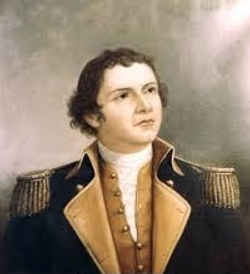
Hugh Mercer
BIRTH
Jan 16, 1726
Aberdeenshire, Scotland
DEATH
January 12, 1777
Princeton, New Jersey
FAMILY
FATHER:

William Mercer
(1811-1873)
##
Mercer, Hugh
(1726-1777)
Hugh Mercer was a brigadier general in the Continental Army during the American Revolutionary War. He fought in the New York and New Jersey campaign and was mortally wounded at the Battle of Princeton.
HOMES:
MUSEUM
Hugh Mercer Apothecary Shop
1020 Caroline Street, Fredericksburg, VA

4
Hugh Tennant Mercer
(1776-1853)
Places | Image | Address | GPS | Site |
|---|---|---|---|---|
Colonial Williamsburg | 101 Visitor Center Dr, Williamsburg, VA 23185 | MUSEUM | ||
Princeton Battlefield State Park | 500 Mercer Rd, Princeton, NJ 08540 | PARK | ||
Charlton's Coffeehouse | 429 E Duke of Gloucester St, Williamsburg, VA 23185 | MUSEUM | ||
Marlborough Marker | 1080 Jefferson Davis Hwy, Fredericksburg, VA 22405 | MARKER |
DIED:
Princeton, New Jersey
Jan 12, 1777


He was born in Pitsligo, Aberdeenshire, Scotland, and studied medicine at the University of Aberdeen. He served as an assistant surgeon in Charles Edward Stuart's army during the Battle of Culloden in the Jacobite rising of 1745. After the failed uprising, Mercer escaped to the colonial-era Province of Pennsylvania, where he lived in Greencastle, Pennsylvania, which is present-day Mercersburg, Pennsylvania, and Fredericksburg, Virginia. He worked as a physician, and established an apothecary. He served alongside George Washington in the provincial troops during the French and Indian War, and he and Washington became close friends.
In 1774, George Washington sold Ferry Farm, his childhood home, to Mercer, who wanted to make this prized land into a town where he and his family would settle for the remainder of his days. During 1775, Mercer was a member of the Fredericksburg Committee of Safety, and on April 25, he was one of the members of the Independent Company of the Town of Fredericksburg who sent a letter of concern to then Colonel George Washington when the British removed gunpowder from the magazine at Williamsburg.
Mercer was placed in charge of a large troop of Pennsylvania Militia stationed in Paulus Hook, New Jersey to protect from potential attack from British troops in Staten Island. Before the New York City Campaign, Washington had ordered two forts built to repel the Royal Navy. On the New York side of the Hudson River, Fort Washington was constructed, and Mercer himself oversaw the building of the earthen fortification on the New Jersey side, named Fort Lee. The British captured Fort Washington on 16 November 1776, and the Americans abandoned Fort Lee four days later. The retreat to New Jersey became known as "the Crisis of the Revolution", because the enlistments of most of Washington's soldiers ended on New Year's Day 1777.
Mercer led a raid on Richmondtown, Staten Island on October 15, 1776, temporarily securing the town and taking as prisoners those inside the makeshift hospital of St. Andrew's Church, but was repelled back to New Jersey, releasing the prisoners and causing numerous British casualties in the process. Some historical accounts credit Mercer with the suggestion for George Washington's crossing of the Delaware River, which resulted in a surprise attack on the Hessians at the Battle of Trenton on December 26, 1776. The victory at Trenton (and a small monetary bonus) made Washington's men agree to a ten-day extension to their enlistment. When Washington decided to face off with Cornwallis during the Second Battle of Trenton on January 2, 1777, Mercer was given a major role in the defense of the city.