

George Monck, 1st Duke of Albemarle
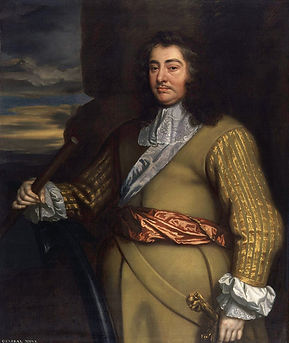
(1608-1670)
BIRTH
December 6, 1608
PLACE
Great Torrington, England
DEATH
January 3, 1670
PLACE
London, England
FAMILY

FATHER
Thomas Monck
(c. 1570–1627)
MOTHER
Elizabeth Smith
(dates unknown)
WIFE
Anne Monck
(1619-1670)
HOMES
NICKNAMES
Honest George
POLITICAL VIEWS
STUART RESTORATION SUPPORTER
RELIGIOUS VIEWS
RELIGION NOT DOCUMENTED
DENOMINATION NOT DOCUMENTED
MEMBERSHIPS
FELLOW OF THE ROYAL SOCIETY
AWARDS
ORDER OF THE GARTER RECIPIENT
George Monck was a Soldier and admiral who marched his army from Scotland to London in 1660 and secured the Restoration of Charles II. He is said to have left home as a young man after a quarrel with the local sheriff's officers. Monck fought for Charles I in Ireland, was captured at Nantwich in January 1644, and spent two years in the Tower of London. Cromwell left him as commander in Scotland, where he held the country with a disciplined army.
EARLY LIFE
George Monck was born on December 6, 1608, at Potheridge, near Great Torrington in Devon, the younger son of Sir Thomas Monck, a gentry family whose finances were strained. He is said to have left home as a young man after a quarrel with the local sheriff's officers. He began soldiering in the Cadiz expedition of 1625 and the La Rochelle expedition of 1627, then spent years in the Dutch service, learning siege warfare before returning to England in 1638 to serve against the Scots.
George Monck was a professional soldier whose changing service connected the Civil Wars with the Restoration of the monarchy. After fighting in the Netherlands, he served Charles I in Ireland and England. Captured at Nantwich in 1644, he spent time in parliamentary custody before accepting service under Parliament. His subsequent commands in Ireland and Scotland made him an important officer in the regime that emerged from the king's defeat.
Under Oliver Cromwell he helped subdue Scotland and eventually commanded the army there. He also served at sea as a general-at-sea during the First Anglo-Dutch War, participating in the fleet's major operations in 1653. The regiment he raised in 1650 later became the Coldstream Guards. His reputation rested on discipline, administrative competence and the loyalty of his troops, resources that became politically decisive after Cromwell's death in 1658.
Monck initially supported Richard Cromwell, but the collapse of the Protectorate and struggles among army factions brought him south from Scotland in early 1660. In London he promoted the restoration of parliamentary authority and the return of members previously excluded from the Commons. He cautiously managed contacts with royalists while avoiding a premature declaration that might have divided his soldiers. Elections to the Convention Parliament opened the way for Charles II's return.
His recommendations helped shape the Declaration of Breda, and the restored king rewarded him with the dukedom of Albemarle and high military office. Monck assisted in reorganizing and reducing the army while preserving a force loyal to the crown. During the Second Anglo-Dutch War he again commanded at sea, including the Four Days' Battle in 1666. His career ended within the restored monarchy he had helped make possible. It shows how control of a disciplined army could enable a political settlement, even when the commander had previously served opposing sides.
CAREER
DEATH
Command of the fleet was given to James, Duke of York, with Sandwich as his deputy and Monck took over his administrative duties at the Admiralty. He also gained a great deal of popularity for remaining in London throughout the 1665 Great Plague when most of the government fled to Oxford. Monck and Prince Rupert shared command during the 1666 campaign; the Four Days' Battle in June was a Dutch victory, offset by English success at the St. James's Day Battle in July. In September he was recalled to help maintain order in the chaos created by the Great Fire of London. This was his last active command; the fleet had to be laid up due to lack of money, culminating in the humiliating raid on the Medway in June 1667 which ended the war. One of the few to escape censure by Parliament, Monck was appointed First Lord of the Treasury but he was now suffering from severe oedema which limited his ability to attend meetings. He died on 3 January 1670, followed three weeks later by his wife, and was buried in Westminster Abbey. Some years later, a monument by William Kent and Peter Scheemakers was erected in the Abbey in Monck's honour. The ballad "On the Death of His Grace, the Duke of Albemarle" was composed in his honour.
Westminster Abbey
20 Dean's Yard, City of Westminster, SW1P 3PA, United Kingdom

GRAVE

POPULAR BIOGRAPHIES
The list combines modern and early biographies with a related biography covering his naval and Restoration circle.
1. General Monck — Maurice Ashley. Find on Amazon
2. Monk — Julian Corbett. [Early scholarly biography] Find on Amazon
3. The Life of General Monck, Duke of Albemarle — Thomas Gumble. [Contemporary biography] Find on Amazon
4. The Life of General Monk, Duke of Albemarle — Thomas Skinner. [Early biography] Find on Amazon
5. Cromwell's Earl: A Life of Edward Mountagu, 1st Earl of Sandwich — Richard Ollard. [Related biography covering Monck's naval and Restoration circle] Find on Amazon
105511