

Erasmus
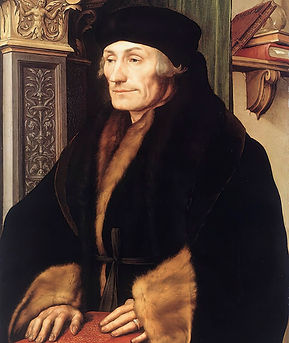
(1466-1536)
BIRTH
1466
PLACE
Rotterdam, Netherlands
DEATH
July 12, 1536
PLACE
Basel, Switzerland
FAMILY

FATHER
Gerard
(dates unknown)
CHILDREN
Margaretha Rogerius
(dates unknown)
HOMES
POLITICAL VIEWS
ANTI-WAR ADVOCATE
RELIGIOUS VIEWS
CHRISTIAN
CATHOLIC
MEMBERSHIPS
AUGUSTINIAN CANONS MEMBER
AWARDS
Desiderius Erasmus was a Dutch Christian humanist who advocated learned piety, education and a return to early sources. His Greek New Testament and revised Latin translation brought textual criticism into biblical study, while The Praise of Folly satirized social and religious pretensions. He criticized abuses within the Church but rejected Luther’s approach, debating him over free will. He died in Basel in 1536. His birth year in the 1460s remains disputed.
EARLY LIFE
Erasmus was born in Rotterdam, probably in 1466, the illegitimate son of Gerard, a priest, and Margaretha, a physician's daughter. He was educated at schools in Gouda and Deventer, where he was influenced by the Brethren of the Common Life. After both his parents died of the plague, his guardians sent him to a monastery, and in 1487 he entered the Augustinian canonry at Steyn, taking vows the following year. He was ordained a priest in 1492. Soon afterward he became secretary to the bishop of Cambrai, who allowed him to study theology at the University of Paris.
Desiderius Erasmus developed his career as a humanist scholar after entering an Augustinian religious house and being ordained. Work for the bishop of Cambrai enabled study in Paris, where he supported himself partly through teaching. Travels in England brought him into contact with Thomas More and John Colet and strengthened his interest in reform through education and the study of Christian texts. His expanding network of patrons, printers, and correspondents allowed him to work across Europe rather than remain in a single institutional post.
Erasmus published the Adages, a collection of classical sayings, in an early form in 1500 and enlarged it repeatedly. Works such as De copia and the Colloquies helped students develop flexible and effective Latin. The Handbook of the Christian Soldier urged an inward, ethically serious religion rather than reliance on ceremonies alone. The Praise of Folly, written during a visit to More and published in 1511, used satire to expose vanity and abuses among scholars, clergy, rulers, and ordinary believers. Its irony prevents every statement by the fictional speaker from being treated as a direct declaration of Erasmus's views.
In 1516 he published an edition of the Greek New Testament with a revised Latin translation and annotations. Although the edition had limitations and was based on a relatively small manuscript base, it made textual comparison central to theological scholarship and influenced later translators. He also edited and translated writings of the Church Fathers and classical authors. His program linked accurate language, historical understanding, and the philosophy of Christ, advocating religious renewal through learning and moral conduct.
The Reformation transformed the reception of his work. Erasmus criticized ecclesiastical abuses but declined to join Martin Luther's break with Rome. His discussion of free will in 1524 drew Luther's forceful response and exposed their disagreement over human agency and salvation. Suspicion from both Protestant and Catholic opponents narrowed the space for his conciliatory approach. Based for substantial periods in Basel, he moved to Freiburg when Basel adopted the Reformation, then returned near the end of his life. He died in 1536. His career helped create the tools and intellectual expectations of Renaissance scholarship while showing the difficulty of pursuing moderate reform during confessional conflict.
CAREER
DEATH
When his strength began to fail, he finally decided to accept an invitation by Queen Mary of Hungary, Regent of the Netherlands (sister of his former student Archduke Ferdinand I and Emperor Charles V), to move from Freiburg to Catholic Brabant. In 1535, he moved back to the Froben compound in Protestant Basel in preparation (Œcolampadius having died, and private practice of Catholic religion now possible.) He saw his last major works, notably Ecclesiastes, through publication, though he grew more frail. On 12 July 1536, he died from an attack of dysentery. He had remained loyal to Roman Catholicism, but biographers have disagreed whether to treat him as an insider or an outsider. He may not have received or had the opportunity to receive the last rites of the Catholic Church; the contemporary reports of his death do not mention whether he asked for a Catholic priest or not, if any were secretly or privately in Basel. He was buried with great ceremony in the Basel Minster (the former cathedral). The Protestant city authorities remarkably allowed his funeral to be an ecumenical Catholic requiem Mass. Erasmus had received dispensations (from Ferdinand Archduke of Austria, and from Emperor Charles V in 1530) to make a will rather than have his wealth revert to his order (the Chapter of Sion), or to the state, and had long pre-sold most of his personal library of almost 500 books to Polish humanist Jan Łaski. As his heir or executor he instated Bonifacius Amerbach to give scholarships to local students and the needy.
Basel Minster
Münsterplatz 9, 4051 Basel, Switzerland

GRAVE
POPULAR BIOGRAPHIES
1. Erasmus: His Life, Works, and Influence — Cornelis Augustijn. Find on Amazon
2. Erasmus and the Age of Reformation — Johan Huizinga. Find on Amazon
3. Erasmus: A Critical Biography — Léon-E. Halkin. Find on Amazon
4. Erasmus, Man of Letters: The Construction of Charisma — Lisa Jardine. [Intellectual biography] Find on Amazon
5. Erasmus of Rotterdam — Stefan Zweig. Find on Amazon
102302