

Crispus Attucks
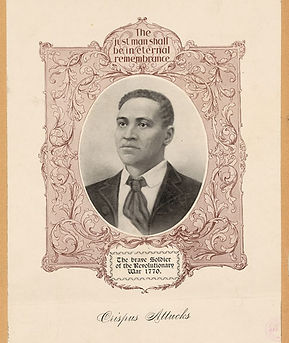
(c. 1723-1770)
BIRTH
c. 1723
PLACE
Framingham
DEATH
March 5, 1770
PLACE
Boston
FAMILY
HOMES
RELIGIOUS VIEWS
RELIGION NOT DOCUMENTED
DENOMINATION NOT DOCUMENTED
MEMBERSHIPS
AWARDS
Crispus Attucks was a sailor of African and Indigenous ancestry killed by British soldiers in the Boston Massacre on March 5, 1770. Born around 1723, he may be the escaped enslaved man described in a 1750 advertisement, but how he obtained freedom is unknown. Early reports called him Michael Johnson, perhaps an alias. Buried with the other victims in Boston, he became a symbol of Black participation in the Revolution, promoted by abolitionist William Cooper Nell.
EARLY LIFE
Crispus Attucks was born on or about c. 1723 in Framingham. The names of the parents are not yet securely established in this database. The surviving evidence represented in this record does not always preserve the details of childhood schooling, household routine, religious instruction, apprenticeship, or youthful travel.
Crispus Attucks worked as a sailor in the Atlantic maritime economy before his death in the Boston Massacre made him a symbol of resistance to British rule. Contemporary reports identify his occupation, his origins in Framingham, Massachusetts, and a connection with New Providence in the Bahamas. They also indicate that his ship was bound for North Carolina. These details establish seafaring work without a continuous record of voyages or employers.
A 1750 advertisement sought the return of an enslaved man called "Crispas," whose age, appearance, and location suggest he was Attucks. The identification is widely accepted but does not explain how he subsequently lived or secured freedom. Reports surrounding his death sometimes called him Michael Johnson, possibly an alias. His African and Indigenous ancestry was recorded using contemporary racial classifications; precise details of his family remain uncertain.
On March 5,1770, Attucks was among sailors who moved toward King Street during a confrontation involving townspeople and British troops. Witnesses placed him near the front with a wooden club. Amid shouting, thrown objects, and confusion, soldiers fired into the crowd. Two bullets struck him, killing him immediately. Four other men died that night or afterward from their wounds. Testimony differed over the actions preceding the shooting, so later portrayals of Attucks as either a deliberate revolutionary leader or solely an aggressor exceed what can be established.
His body lay at Faneuil Hall before a public funeral and burial with the other victims. In the soldiers' trial, defense lawyer John Adams used racial and class prejudice in describing the crowd. During the nineteenth century, abolitionists including William Cooper Nell reclaimed Attucks as evidence of Black participation in the struggle for liberty. His career was that of a working sailor; his public importance also reflects the political uses of his death and struggles over the national story.
CAREER
DEATH
Boston Massacre Site
Boston Massacre Site Marker, east side of Old State House, 206 Washington St, Boston, MA 02109


Crispus Attucks was a sailor of African and Indigenous ancestry killed by British soldiers in the Boston Massacre on March 5, 1770. Early reports called him Michael Johnson, perhaps an alias. Buried with the other victims in Boston, he became a symbol of Black participation in the Revolution, promoted by abolitionist William Cooper Nell. Five colonists were killed and six were wounded. Attucks took two ricocheted bullets in the chest and was believed to be the first to die. County coroners Robert Pierpoint and Thomas Crafts Jr. conducted an autopsy on Attucks. He was approximately 47 years old. The events of the earlier public career provide context for the final period but should not be mistaken for evidence of the immediate physical cause. Illnesses, injuries and deaths involving relatives or contemporaries are separate events. No further cause is inferred from age, occupation or the place of death. Where the account does not identify an illness or injury explicitly, the medical circumstances remain uncertain rather than a basis for a more elaborate final-days scene.
Granary Burying Ground
Tremont Place, Boston, Massachusetts, 02133, USA
GRAVE

POPULAR BIOGRAPHIES
The list combines biographies where available with clearly labelled related studies, memoirs, primary accounts or reference works.
1. First Martyr of Liberty: Crispus Attucks in American Memory — Mitch Kachun. [Biography and study of his commemoration] Find on Amazon
2. Crispus Attucks: Black Leader of Colonial Patriots — Dharathula H. Millender. [Younger-reader biography] Find on Amazon
3. Crispus Attucks: Hero of the Boston Massacre — Anne Beier. [Younger-reader biography] Find on Amazon
4. Black Patriots and Loyalists: Fighting for Emancipation in the War for Independence — Alan Gilbert. [Collective history and biographical context] Find on Amazon
5. The Boston Massacre — Hiller B. Zobel. [Study of his death and its setting] Find on Amazon
102030