

Confucius
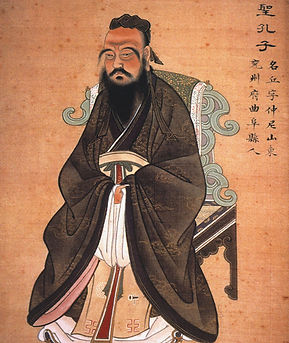
(551 BC-479 BC)
BIRTH
551 BC
PLACE
Qufu, China
NAME
Kong Qiu
DEATH
479 BC
PLACE
Qufu, China
FAMILY

FATHER
Shuliang He
(dates unknown)
MOTHER
Yan Zhengzai
(dates unknown)
WIFE
Qiguan
(d. 485 BCE, traditional and disputed)
HOMES
POLITICAL VIEWS
CONFUCIAN POLITICAL PHILOSOPHY
RELIGIOUS VIEWS
CHINESE TRADITIONAL RELIGION
DENOMINATION NOT DOCUMENTED
MEMBERSHIPS
AWARDS
Confucius, or Kong Qiu, was a teacher from the Chinese state of Lu, traditionally dated 551–479 BCE. He taught moral cultivation, humane conduct, filial responsibility and government through virtuous example, drawing on Zhou ritual and music. Sayings attributed to him were collected in the Analects and other texts after his lifetime. His legacy shaped education and political thought across East Asia, though details of his career and the early texts remain debated.
EARLY LIFE
Confucius, whose personal name was Kong Qiu, was born in 551 BC in Zou, near Qufu, in the state of Lu in eastern China, in what is now Shandong Province. His father, Shuliang He, was an elderly military officer who died when Confucius was about three years old, and he was raised in modest circumstances by his mother, Yan Zhengzai. He was largely self-taught and developed a deep interest in the rituals, music and history of the early Zhou dynasty. As a young man he held minor posts, including manager of granaries and of livestock, and he married at about nineteen.
Confucius worked as a teacher and adviser in the politically divided world of late Zhou China. Traditionally dated to 551–479 BCE, he belonged to the state of Lu and sought to recover the ethical value of inherited ritual, music and learning. Early texts associate him with administrative service, but disagree over his offices and their importance. Later biographies give him a more systematic political career than the surviving contemporary evidence can establish. His teaching activity is better understood through sayings and encounters preserved after his death than through a secure sequence of official appointments.
According to the traditional account, he left Lu around 497 BCE and travelled among other states with followers, hoping to find a ruler willing to govern according to his principles. Narratives place him in Wei, Song, Chen, Cai and other territories, sometimes frustrated or endangered. These stories explain his ideals through exemplary situations, and their details should not all be read as independently verified episodes. His return to Lu is generally placed around 484 BCE. In his final years teaching and the transmission of inherited culture became central to the later picture of his activity.
The Analects represents Confucius as demanding moral effort from rulers and students alike. Humane concern, ritual propriety, filial responsibility, trustworthiness and learning were mutually reinforcing practices. A ruler should lead by cultivated character and worthy example rather than rely entirely on punishments. Ritual was more than outward ceremony: proper participation could shape emotions and responsibilities within families and communities. The exemplary person was defined by conduct and effort, not inherited rank. He adapted instruction to particular students and emphasized acknowledging the limits of knowledge.
Confucius did not leave a treatise setting out a finished system. The Analects developed through transmission and compilation by disciples and later communities, and other early works preserve different portraits of him. Traditional claims that he edited all the major classics therefore require qualification. His posthumous influence grew through thinkers such as Mencius and Xunzi and through Han-era institutions of learning. Later interpretations, especially those associated with Zhu Xi, reshaped the educational canon across East Asia. His teaching joined personal cultivation, cultural inheritance and the obligations of government.
CAREER
DEATH
Confucius died in 479 BC in the state of Lu, traditionally at about 72 or 73 years of age. His final years followed a return from extended travels in search of a ruler willing to put his political and ethical ideas into practice. In Lu he was remembered chiefly as a teacher, with disciples preserving the sayings and traditions later associated with his name. The deaths of people close to him, including his son and favored followers, form part of the traditional account of his later life. They should be distinguished from evidence about his own medical condition. Ancient sources describe his disappointment and reflections on the limits of his mission, but they do not establish a precise terminal disease or provide a clinical chronology. Stories of omens, dreams and last sayings belong to the biographical tradition and require attribution rather than presentation as independently verified events. He was buried near Qufu, where his tomb became a major site of remembrance. The supported account is the death of an elderly teacher after his return to Lu, with the cause and detailed physical circumstances left uncertain. A particular infection, stroke or other modern diagnosis cannot responsibly be inferred from his age or the literary descriptions of his final mood.
Cemetery of Confucius
Cemetery of Confucius, Qufu, Shandong, China

GRAVE
POPULAR BIOGRAPHIES
1. The Authentic Confucius: A Life of Thought and Politics — Annping Chin. Find on Amazon
2. Confucius: A Throneless King — Meher McArthur. Find on Amazon
3. Confucius: A Biography — Jonathan Clements. Find on Amazon
4. Lives of Confucius: Civilization's Greatest Sage Through the Ages — Michael Nylan and Thomas Wilson. [Biography and reception history] Find on Amazon
5. Confucius: And the World He Created — Michael Schuman. [Life and legacy] Find on Amazon
102778