

Christopher Columbus
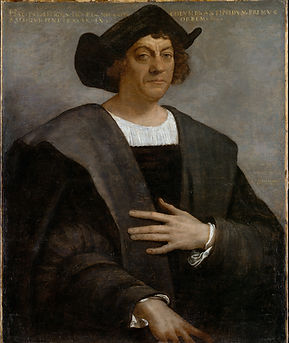
(c. 1451-1506)
BIRTH
c. 1451
PLACE
Genoa, Italy
DEATH
May 20, 1506
PLACE
Valladolid, Spain
FAMILY

FATHER
Domenico Colombo
(c. 1418–between 1494 and 1500)
MOTHER
Susanna Fontanarossa
(died before September 1484)
WIFE
Filipa Moniz Perestrelo
(d. c. 1484)
HOMES
POLITICAL VIEWS
INDIGENOUS FORCED LABOR POLICY ADVOCATE
RELIGIOUS VIEWS
CHRISTIAN
CATHOLIC
MEMBERSHIPS
AWARDS
Christopher Columbus (1451–1506) was a Genoese navigator who sought a westward route to Asia in Spanish service. His 1492 voyage reached the Caribbean, and the Taíno, and three further voyages explored islands and mainland coasts. His colonial rule involved forced labor and enslavement and conflict with settlers and the crown. Still believing he had reached Asia, he died after losing authority. The voyages began lasting Atlantic colonization.
EARLY LIFE
Christopher Columbus was born in 1451 in the Republic of Genoa, in present-day Italy, the son of Domenico Colombo, a wool weaver, and Susanna Fontanarossa. He went to sea as a young man and sailed on trading voyages in the Mediterranean. In 1476 he survived a shipwreck off the coast of Portugal and settled in Lisbon, where his brother Bartholomew was a mapmaker. He sailed to the Atlantic islands, England and West Africa. In about 1479 he married Filipa Moniz Perestrelo, and their son Diego was born in about 1480.
Christopher Columbus developed his proposal for reaching Asia by sailing west within the maritime world of the Mediterranean and Atlantic. He sought royal sponsorship after experience in Portuguese trading networks, but underestimated the distance across the ocean. The plan depended on mistaken geographical calculations, not on proving that the Earth was round, a view already accepted by educated contemporaries. After prolonged negotiation Ferdinand and Isabella supported an expedition in 1492, granting titles and prospective privileges tied to the lands and trade he expected to reach.
His fleet left Spain in August and made landfall in the Bahamas in October 1492, encountering Indigenous communities rather than an empty or unknown human world. He explored parts of Cuba and Hispaniola and returned with reports intended to secure support. A much larger second expedition in 1493 established a colonial settlement and imposed demands for labour, gold and submission. Violence, enslavement and disruption of Indigenous life were central to the enterprise. Columbus governed amid resistance from Taíno communities, disputes among colonists and expectations from the Spanish crown that the venture should yield wealth.
A third voyage in 1498 brought him to Trinidad and the South American coast, expanding his observations without persuading him that he had reached a separate continent. Complaints about government on Hispaniola led royal commissioner Francisco de Bobadilla to arrest him in 1500 and send him to Spain in chains. The monarchs released him but did not restore his former governing authority. A fourth voyage from 1502 to 1504 explored Central American coasts in search of a passage, bringing hardship, shipwreck and an extended stay in Jamaica before rescue. His navigational persistence coexisted with major failures of administration and interpretation.
In his final years Columbus pressed claims to revenues and privileges and sought to frame his achievements for royal patrons. He died in Valladolid in 1506, still understanding the voyages in relation to Asia. The crossings initiated sustained European colonization of the Americas, but later celebrations often obscured the peoples already living there and the coercive character of the first colonies. His surviving writings are valuable evidence of intentions and perceptions, while also serving claims of authority and reward. Conquest, disease and forced labour reshaped Atlantic societies beyond his own purposes.
CAREER
DEATH
The attacks increased in duration and severity, sometimes leaving Columbus bedridden for months at a time, and culminated in his death 14 years later. Based on Columbus's lifestyle and the described symptoms, some modern commentators suspect that he suffered from reactive arthritis, rather than gout. Reactive arthritis is a joint inflammation caused by intestinal bacterial infections or after acquiring certain sexually transmitted diseases (primarily chlamydia or gonorrhea). After his arrival to Sanlúcar during his fourth voyage (and Queen Isabella's death), an ill Columbus settled in Seville in April 1505. There, he continued to make pleas to the Crown to defend his own personal privileges and his family's. He moved to Segovia, where the court was located at the time, travelling by mule in early 1506. In March 1506, after the wedding of King Ferdinand and Germaine of Foix in Valladolid, Spain; Columbus followed in order to continue his pleas. On 20 May 1506, aged 54, Columbus died in Valladolid.
Seville Cathedral & Giralda
2 Calle Rodríguez Zapata, Seville, Andalusia, 41004, Spain

GRAVE


MUSEUM
Royal Alcázar of Seville
Patio de Banderas, s/n, Seville, Andalusia 41004, Spain

CHURCH
Seville Cathedral & Giralda
2 Calle Rodríguez Zapata, Seville, Andalusia, 41004, Spain

PARK
Salt River Bay National Park (Columbus Landing)
Salt River Road, Salt River, United States Virgin Islands, 00851, USA
POPULAR BIOGRAPHIES
1. Columbus: The Four Voyages — Laurence Bergreen. Find on Amazon
2. Columbus — Felipe Fernández-Armesto. Find on Amazon
3. Admiral of the Ocean Sea: A Life of Christopher Columbus — Samuel Eliot Morison. Find on Amazon
4. The Worlds of Christopher Columbus — William D. Phillips Jr. and Carla Rahn Phillips. [Life and historical context] Find on Amazon
5. The Nine Lives of Christopher Columbus — Matthew Restall. [Biography and reception history] Find on Amazon
103042