

Charles II
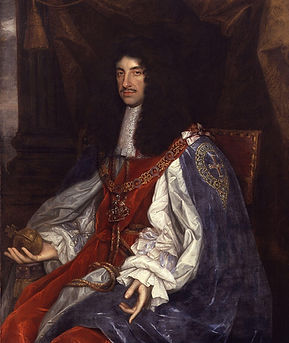
(1630-1685)
BIRTH
May 29, 1630
PLACE
London, England
NAME
Charles Stuart
DEATH
February 6, 1685
PLACE
London, England
FAMILY

FATHER
Charles I of England
(1600-1649)

MOTHER
Henrietta Maria of France
(1609-1669)
SISTER
Mary, Princess Royal
(1631–1660)
WIFE
Catherine of Braganza
(1638-1705)
HOMES
NICKNAMES
Merry Monarch; Old Rowley
RELIGIOUS VIEWS
CHRISTIAN, RELIGIOUS CONVERT
ANGLICAN, CATHOLIC, CATHOLIC CONVERT
MEMBERSHIPS
ROYAL SOCIETY FOUNDER-PATRON
AWARDS
Charles II was restored to the throne of England, Scotland, and Ireland in 1660 after years of exile, reigning until 1685 over a period known as the Restoration. He escaped after hiding in an oak tree at Boscobel and spent the next nine years in exile in France, Germany, and the Spanish Netherlands. He chartered the Royal Society and married Catherine of Braganza in 1662. Charles had many mistresses and illegitimate children but no legitimate heir.
EARLY LIFE
Charles was born on May 29, 1630, at St James's Palace in London, the eldest surviving son of Charles I and Henrietta Maria of France. He was educated by tutors including the philosopher Thomas Hobbes, who taught him mathematics. When the Civil War broke out in 1642, he accompanied his father and at fourteen was given nominal command in the West Country. As the royalist cause collapsed in 1646, he escaped to the Scilly Isles, Jersey, and then France. After his father's execution in 1649, he was proclaimed king by the Scots, and he was crowned at Scone in 1651.
Charles II's political career was shaped by civil war, exile, and the restoration of monarchy. After his father's execution in 1649, he sought support in Scotland, accepted conditions imposed by the Covenanters, and was crowned at Scone in January 1651. His invasion of England ended in defeat by Oliver Cromwell at Worcester that September. He escaped and spent years abroad, seeking allies and resources while the Commonwealth and Protectorate governed his former kingdoms.
The collapse of the Protectorate and George Monck's intervention made restoration possible. Charles's Declaration of Breda offered assurances concerning pardon, property, and religious settlement, subject to parliamentary decisions. He returned in May 1660 and was crowned in England in 1661. The monarchy and episcopal churches were restored, while legislation restricted religious dissent and selected regicides were punished. The settlement recovered royal institutions without removing Parliament's role in taxation and law. Governing Scotland through ministers such as Lauderdale brought coercion and conflict with Covenanters.
Charles's reign included the plague of 1665 and the great fire of London in 1666, followed by extensive rebuilding. His patronage encouraged court culture and scientific activity, including royal charters for the Royal Society. War with the Dutch Republic exposed financial and naval weaknesses, particularly the Dutch raid on the Medway in 1667. Relations with France offered another source of support. The secret Treaty of Dover in 1670 linked him to Louis XIV and included a promise of Catholic conversion; its religious provisions were concealed from the wider political nation.
Attempts to ease restrictions on Catholics and Protestant dissenters produced disputes over the king's power to suspend laws. The Declaration of Indulgence was withdrawn, and the Test Act of 1673 reinforced Protestant qualifications for office. Anti-Catholic panic surrounding the fabricated Popish Plot intensified the succession crisis. Charles and Catherine of Braganza had no surviving legitimate children, making his Catholic brother James heir. Charles resisted efforts to exclude James, dissolved hostile Parliaments, and governed without another Parliament after 1681. Royal authority recovered in his final years through action against opponents and tighter control of borough institutions. He died in 1685 after receiving Catholic rites, and James succeeded him.
CAREER
DEATH
Charles suffered a sudden apoplectic fit on the morning of 2 February 1685, and died four days later at the Palace of Whitehall, at 11:45 am, aged 54. The suddenness of his illness and death led to suspicion of poison in the minds of many, including one of the royal doctors, but a more modern medical analysis has held that the symptoms of his final illness are similar to those of uraemia, a clinical syndrome due to kidney dysfunction. Charles had a laboratory among his many interests where, prior to his illness, he had been experimenting with mercury. Mercuric poisoning can produce irreversible kidney damage, but the case for that being a cause of his death is unproven. In the days between his collapse and his death, Charles endured a variety of torturous treatments, including bloodletting, purging and cupping, in the hope of effecting a recovery, which may have exacerbated his uraemia through dehydration, rather than helping to alleviate it. On his deathbed, Charles asked his brother, James, to look after his mistresses: "be well to Portsmouth, and let not poor Nelly starve". He told his courtiers, "I am sorry, gentlemen, for being such a time a-dying", and expressed regret at his treatment of his wife. On the last evening of his life he was received into the Catholic Church, in the presence of Father John Huddleston, though the extent to which he was fully conscious or committed, and with whom the idea originated, is unclear.
Westminster Abbey
20 Dean's Yard, City of Westminster, SW1P 3PA, United Kingdom

GRAVE

POPULAR BIOGRAPHIES
1. King Charles II — Antonia Fraser. Find on Amazon
2. Charles the Second: King of England, Scotland, and Ireland — Ronald Hutton. Find on Amazon
3. Charles II — John Miller. Find on Amazon
4. A Gambling Man: Charles II's Restoration Game — Jenny Uglow. Find on Amazon
5. Charles II: The Star King — Clare Jackson. Find on Amazon
103253