

Andrew Johnson
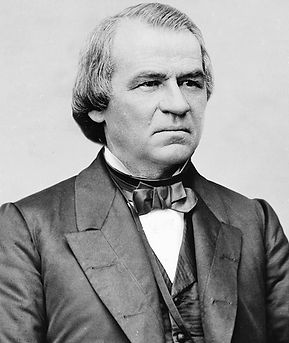
(1808-1875)
BIRTH
December 29, 1808
PLACE
Raleigh, North Carolina
DEATH
July 31, 1875
PLACE
Elizabethton, Tennessee
FAMILY

FATHER
Jacob Johnson
(1778–1812)
MOTHER
Mary McDonough
(1783–1856)
HOMES
NICKNAMES
Sir Veto; the Tailor President
POLITICAL VIEWS
CIVIL RIGHTS LEGISLATION OPPONENT
DEMOCRATIC, NATIONAL UNION PARTY
RELIGIOUS VIEWS
CHRISTIAN
NO DENOMINATIONAL AFFILIATION
MEMBERSHIPS
AWARDS
Andrew Johnson of Tennessee became the 17th president of the U.S. after Abraham Lincoln's assassination in 1865, clashed with Congress over Reconstruction, and was the first president impeached. When Tennessee seceded, he was the only senator from a seceding state who kept his seat. Lincoln made him military governor of Tennessee in 1862. Elected vice president on Lincoln's National Union ticket in 1864, Johnson became president on April 15, 1865.
EARLY LIFE
Andrew Johnson was born on December 29, 1808, in Raleigh, North Carolina, the son of Jacob Johnson, a porter and handyman, and Mary McDonough, a weaver. His father died when he was three, and the family lived in poverty. He never attended school. As a boy he was apprenticed to a tailor, but he ran away in 1824. In 1826 he settled in Greeneville, Tennessee, where he opened a tailor shop. In 1827 he married Eliza McCardle, who helped him improve his reading and writing. He entered local politics as a champion of working men and small farmers and served as alderman and mayor of Greeneville.
Andrew Johnson built his political career in Tennessee while operating a tailoring business. He served in local government and the state legislature before entering the United States House of Representatives in 1843. During ten years in Congress he advocated inexpensive land for settlers and presented himself as a defender of white working people against wealthy interests. As Tennessee governor from 1853 to 1857 he supported education and public improvements; election to the Senate followed in 1857.
Although a slaveholder and Democrat, Johnson rejected secession. He remained in the Senate when Tennessee left the Union in 1861, making him the only senator from a seceding state to retain his seat. Abraham Lincoln appointed him military governor of Tennessee in 1862. He worked to restore Union authority under wartime conditions and eventually endorsed emancipation.
Johnson became president after Lincoln's assassination in April 1865. His Reconstruction program offered pardons and permitted southern states to restore governments with limited federal requirements. Former Confederate leaders regained influence, and new state governments enacted Black Codes restricting freed people's rights. Johnson opposed broad federal protection of African American citizenship and insisted that Reconstruction largely belonged to the executive branch and the returning states.
His vetoes of the Freedmen's Bureau legislation and the Civil Rights Act of 1866 deepened conflict with Congress. Republicans overrode the civil rights veto, and the Fourteenth Amendment and Reconstruction Acts moved policy away from his approach. His public campaign against congressional opponents failed in the 1866 elections.
The House impeached Johnson in February 1868 after he attempted to remove Secretary of War Edwin Stanton under disputed legal authority. The Senate fell one vote short of the two-thirds majority required to convict, leaving him in office but with sharply reduced political authority. His administration also included the 1867 purchase of Alaska, negotiated by Secretary of State William Seward, and pressure supporting French withdrawal from Mexico. After leaving the presidency in 1869, Johnson unsuccessfully sought other offices before winning election to the Senate in 1875. He died that July. His career illustrates the distinction between preserving the Union and defending equal citizenship: his resistance to Black civil rights severely obstructed the settlement of emancipation.
CAREER
DEATH
Johnson returned home after the special session concluded. In late July 1875, convinced some of his opponents were defaming him in the Ohio gubernatorial race, he decided to travel there to give speeches. He began the trip on July 28, and broke the journey at his daughter Mary's farm near Elizabethton, where his daughter Martha was also staying. That evening he had a stroke, but refused medical treatment until the next day, when he did not improve and two doctors were sent for from Elizabethton. He seemed to respond to their ministrations, but had another stroke on the evening of July 30, and died early the following morning at the age of 66. President Grant had the "painful duty" of announcing the death of the only surviving past president. Northern newspapers, in their obituaries, tended to focus on Johnson's loyalty during the war, while Southern ones paid tribute to his actions as president. Johnson's funeral was held on August 3 in Greeneville. He was buried with his body wrapped in an American flag and a copy of the U.S. Constitution placed under his head, according to his wishes. The burial ground was dedicated as the Andrew Johnson National Cemetery in 1906, and with his home and tailor's shop, is part of the Andrew Johnson National Historic Site.
Andrew Johnson National Cemetery
121 Monument Avenue, Greeneville, TN 37743, USA

GRAVE
POPULAR BIOGRAPHIES
1. Andrew Johnson: A Biography — Hans L. Trefousse. Find on Amazon
2. Andrew Johnson — Annette Gordon-Reed. Find on Amazon
3. Andrew Johnson and Reconstruction — Eric L. McKitrick. [Political biography and history] Find on Amazon
4. Impeached: The Trial of President Andrew Johnson and the Fight for Lincoln's Legacy — David O. Stewart. [Political and legal history] Find on Amazon
5. Andrew Johnson: President of the Border — Robert W. Winston. Find on Amazon
102190